Showing posts with label puzzle. Show all posts

1.26.2010

Breakthru!


story | gameplay | thoughts |
level structure | controls | options

BASIC INFO:
Title ....... Breakthru! (North America)
Players ..... 1-2
Genre ....... puzzle
Sub-genre ... falling tile, matching tile, tile removal
Platform .... DOS (1994), Game Boy (1995), SEGA Saturn (1995), SNES (1994) and Windows 3.x (1994)


The Soviet Mind Game's little cousin.STORY:
None.


GAMEPLAY:
Your goal in Breakthru! is to remove all tiles from the playing field. You begin with a screen that is filled with tiles. There are regular tiles which can be differentiated by pattern (as the Game Boy was monochromatic). You can remove these tiles by clicking on any group of them, even if the group is composed of only 2. When removed, tiles from above fall down, creating new groups that can be removed.

You may have played this before under the name ChainShot! or SameGame. If you have, you'll know it can get very difficult to destroy the last few tiles. Thus, it is helpful that new tiles are constantly falling from the top of the screen. You can force drop these pieces by holding down B and pressing down on the D-pad; you can also position them by holding down B and pressing left or right on the D-pad.

To make it even easier, you have special tiles. These include:
  • wild cards: allow you to destroy all tiles of one type (rare)
  • rockets: flies in 1 direction and destroys all tiles in its flight path
  • bombs: You can choose to detonate any bomb that reaches the bottom row of the playing field. It will destroy every adjacent tile, including diagonally adjacent tiles. If a bomb is one of those diagonally adjacent tiles, it, too, will detonate, following the same rules. If two bombs ever actually touch (diagonals not included) they will automatically detonate.
Another special tile is included whose only purpose is to make things difficult. This is the weight, an obnoxious tile that can only be destroyed by rockets and bombs. Weights must be destroyed in order to proceed to the next stage.

There are also spiders. These are not tiles, and do not need to be destroyed in order to clear a stage. However, they can be destroyed by special tiles such as rockets or bombs. You may want to do this as spiders get in the way of your falling blocks, making it difficult to clear the field.


THOUGHTS:
First things first: if you have full color vision, you probably would prefer a different version of Breakthru!. The monochrome version of the game really tires your eyes out. Unfortunately, the color versions I've seen screenshots for (SNES, Windows 3.x) are not color-blind friendly.

As for the game itself, well...how do you like your SameGame? Personally, I prefer that my falling block puzzles be endless, so Breakthru! is an improvement over the original SameGame rules, where your puzzle ends as soon as you clear or fail to clear the field. However, I think I may prefer the more classic "endless" SameGame rules variant, described on Wikipedia as such:
    "In an "endless" variant, the game starts with an empty field. The blocks or balls start falling down; but if they reach the top, new blocks stop falling, so they do not overflow—thus, the game never ends. The player can end the game at any time by waiting for blocks to reach the top, then performing a special action (for example, right-click instead of left-click)."
On the other hand, I really do like the introduction of special tiles and the spider. These really do change the game in an interesting way, motivating me to plot out my moves in a way the regular game doesn't.

I think, in the end, I'd like to see a reintroduction of Breakthru with a combination of the gameplay from the Game Boy game and the "endless" gameplay described in the above quote. As the player reaches a certain score point, special tiles would generate at different rates (weights becoming more common, for instance), and spiders would spawn where a tile just disappeared.


LEVEL STRUCTURE:
[world #] [level NAME] [round #]

There are 4 "worlds" (for lack of a better term). The first level of every world is called Berlin. In Berlin (as in each of the 6 levels) you play 4 rounds. After you complete the 4th round, you get a "Level Complete" message and move onto the next level. The levels are, in order: Berlin, London, S.F., Moscow, N.Y., and Beijing. There are 98 total rounds on any single difficulty level.

Upon beating 4 Beijing 4, you loop back around to 4 Berlin 1.


CONTROLS:
  • D-pad ... move cursor; (while holding B) position falling puzzle tiles
  • select .. none
  • start ... pause or unpause
  • A ....... press on tiles to make them disappear (regular tiles in groups) or to detonate them (rockets, bombs)
  • B ....... toggles control from the puzzle playing field to control of the falling tiles; must HOLD B down in order to move the falling tiles
  • A + B ... press simultaneously to place a partial grid on the playing field to help you place falling tiles


  • OPTIONS:
    There are 3 difficulty settings (easy, normal, hard). There are 3 time settings (2, 5, and 10 minutes). Music can be toggled on and off. Sound effects can be toggled on and off. The puzzle background can be toggled on and off (fortunate, because it is very distracting. Credits can be accessed at any time from the options menu.

    Bug's Bunny: Crazy Castle 3


    story | gameplay | thoughts |
    level structure | controls | options

    BASIC INFO:
    Title ....... Bug's Bunny: Crazy Castle 3 (North America, Europe, Japan); Soreike! Kid: Go! Go! Kid (Japan)
    Players ..... 1
    Genre ....... platform
    Sub-genre ... puzzle platformer
    Platform .... Game Boy (1999, Japan), Game Boy Color (1999)


    Clever alt text here.STORY:
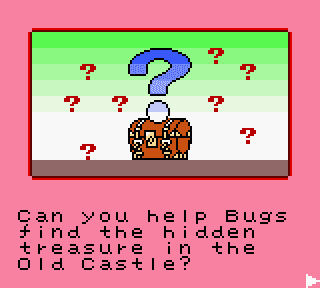
    Bugs Bunny is searching through Old Castle for a great treasure he read about in a book. His friends are under a spell and are trying to stop him.


    GAMEPLAY:
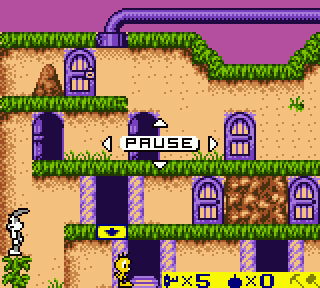
    You can examine the entire level when the game is paused.Your goal in Bugs Bunny: Crazy Castle 3 is to clear all 61 stages of the Old Castle. To clear a stage, you must collect the 8 keys scattered about, then proceed to the locked door which leads to the next stage.
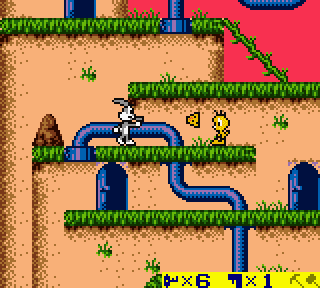
    Simple enough, but there are other characters from the Looney Tunes universe wandering around on screen, and a touch from them is fatal. Furthermore, many will actively attempt to stop your quest...with varying degrees of effectiveness. It is easy enough to avoid the ones who walk very slowly back and forth across a platform. On the other hand, others will chase you throughout the stage, unless you disable them.

    In the end, the blame is pinned on the puddy tat.You can disable your enemies/friends. Or, more accurately, you can blow up, crush, and shoot them with the various items you find laying about (bombs, anvils, and very lethal cork pop guns). Use these items well, and your pursuers will be destroyed with a comic puff of air, leaving you to explore the area at a slightly more leisurely pace.
    As levels become progressively more complex, you can often simply outrun your enemies, using the many stairs, ladders, pipes, vines, ropes, trampolines, and other such whatnot to get around the level. But where's the fun in that?

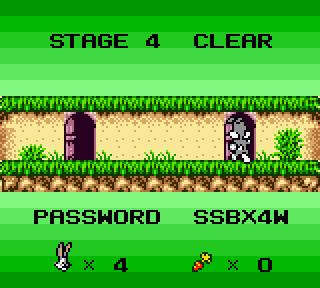
    Complete level, receive password.The game doesn't save your progress, but it does give you passwords. A password saves not just the level you are on, but it also seems to save the number of lives you've earned. Continues in the game are infinite. Additionally, you earn a life every time you complete a stage successfully, find 1ups in stages, and earn 1ups by collecting carrot icons.


    THOUGHTS:
    Thou must.I've heard a lot of praise for the Crazy Castle series, and I have fond memories of Kemco's Bugs Bunny Birthday Blowout for the NES -- a straightforward and simple action-based platformer that I played with my brothers. This game seemed like a winner: I'm a fan of puzzle platformers, I'd had a good experience with the developer making a similar game, and retro gamers agreed it was a good game from a good series. I was happy to get a copy.
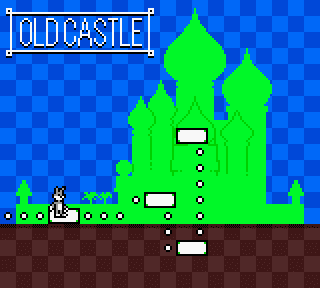
    I was incredibly disappointed the first time I played it. I played the first 2 levels and was, well, bored. I set the game aside down and didn't come back to it again for months.

    The B stands for 'Boring'.I did come back to the game, fortunately. I'm not going to lie, the first 5 stages are terrible -- perhaps less so if you are inexperienced with the genre. But after slogging through those first 5 dull stages, the game starts to get interesting. The levels expand in size and scope, giving you room to decide how you want to solve them. New puzzle elements are often brought into play, and a new set of enemies are introduced in each world (although they differ only in appearance).

    The last levels are huge, sprawling affairs that seem downright overwhelming in scope. However, as you play, a solution falls into place little by little. Finally solving one of these gigantic puzzles gives an intense feeling of satisfaction.


    This castle is old.LEVEL STRUCTURE:
    [world NAME] [stage #]

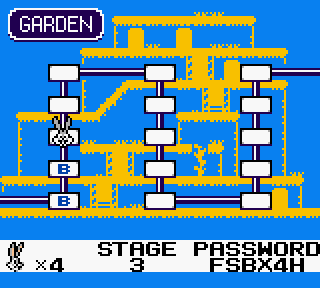
    There are 4 worlds (the Garden, the Hall, the Basement, and the Treasury) that have 15 stages each. Upon completing the 60th stage, you proceed to the final, 61st stage.


    CONTROLS:
    D-pad .... move left or right (left or right); use doors, stairs, vines, pipes, ladders, and so on (up or down)
    select ... nothing
    start .... pause, unpause
    A ........ use items, use switches
    B ........ use items


    OPTIONS:
    None.


    EXTRA NOTES:
    Based on the Looney Tunes cartoon show.

    There are 7 Crazy Castle titles and 1 compilation (to my knowledge, the FDS/NES, Game Boy, and Mobile games under the title "Bugs Bunny Crazy Castle" are not ports but actually different games). Two of the Crazy Castle titles are, in Japan, Mickey Mouse titles, which has its own series (5 releases total).

    The Crazy Castle titles are as follows:
    The Mickey Mouse titles are:


    Wikipedia thinks that The Bugs Bunny Birthday Blowout (1990 FDS/NES) and Mickey's Dangerous Chase (1991-3 GB) are also part of the Crazy Castle series.


    1.25.2010

    Cyraid


    story | gameplay | my thoughts
    level structure | controls | options

    BASIC INFO:
    Title ....... Cyraid (North America); Bakuretsu Senshi Warrior (Japan)
    Players ..... 1-2
    Genre ....... platform
    Subgenre .... puzzle platformer
    Platform .... Game Boy (1)


    Dunno what's up with the space theme.STORY:
    Natasia has been kidnapped. Save her, Warrior and/or Fighter!


    GAMEPLAY:
    Cyraid is a platformer with heavy puzzle elements. Each stage is presented on a single screen and each screen is filled with monsters, ladders, and various kinds of blocks. Each stage has about 6 blocks (give or take) that are labeled E.

    By simultaneously pressing A and the D-pad, you can kick. Given the correct circumstances, you can use kicking to modify everything on the screen. You can destroy blocks, kill enemies, and kick around ladders. Your goal on each stage is to use your elite kicking skills to reach and open all of the E blocks and collect (or destroy) the capsules that drop out from them.

    Every couple minutes, a large, ball-shaped monster appears from some fixed spot on the wall. Any blocks you have destroyed have a chance of reappearing as it stomps about shaking the screen. This can be useful if you find that you have destroyed a block you need to reach a certain area. However, if you are standing on the same spot a block reappears in, you will die instantly.

    Destroying blocks sometimes reveals extra lives and powerups. An x-shaped power-up stacks to give you useful abilities like speed and jumping. This allows you to take shortcuts on stages and finish them up more quickly, but you'll lose them if you die.

    The final level of each world features a boss. Boss levels remind me of fighting Bowser in Super Mario Bros., in that you must dodge the attacks of the boss monster in order to reach a button that destroys the monster.


    THOUGHTS:
    I love this game. I'm not sure I can explain why in any satisfying way. It's hard to get past the "OmigoshCyraidSQUEE!"

    Ultimately, it comes down to the following combination of facts:
    [1] I love puzzle games
    [2] Cyraid is a puzzle game
    [3] I find Cyraid to be challenging, but not brutally hard

    I especially appreciate that Cyraid is an action puzzler. It supports different play styles, which I'll often cycle through. You can be the gamer who sits at the beginning of the stage, not moving until you've planned out every move--and when you get tired of that, next stage you can pick the nearest E-block to open and think on the move. Either way, you'll probably die due to something unforeseen, but you'll be better prepared for the next time you try the stage!

    As you progress in the game, you'll accumulate useful power-ups like jumping and speed. You'll pass through levels with these power-ups, not knowing how to beat them otherwise. Learning how to complete levels with power-ups is challenging in its own right, but learning how to do so without power-ups is also quite fun. While perhaps not everyone interested in Cyraid will be interested in this "hard mode," many of us who are drawn to Cyraid will also be drawn to such a challenge.

    The simple looks of Cyraid are perfect for its nature. The graphics accomplish what they need to. The visuals aren't very detailed, and perhaps you can't tell what an enemy is supposed to be...but, if you are at all familiar with video games, you know it's an enemy and will hurt you if you touch it. Furthermore, each sprite is distinct from the other, and nothing is so distracting that you will get startled and make a stupid mistake.


    LEVEL STRUCTURE:
    [world #] [stage #]

    There are 4 worlds. World 1 has 8 stages, world 2 has 21 stages, and world 3 has 27 stages. I do not know how many stages world 4 has. Sometimes stages can be skipped. You can start at the beginning of any world by using a password: DRAGON (2), SLAYER (3), or RUGGER (4).


    CONTROLS:
    D-pad ...................... move your cursor; move your character
    select ..................... ??
    start ...................... pause
    A .......................... shoot lasers (only if you have "-5-" at the top of your screen AND at least one black bar)
    B .......................... jump (if you have "-4-" or "-5-" at the top of your screen)
    A + D-pad simultaneously .... kick stuff
    select + B simultaneously ... lose a life and start the level over


    OPTIONS:
    None.


    CREDITS:
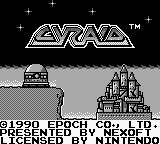
    on title screen:
      CYRAID™
      ©1990 EPOCH CO., LTD.
      PRESENTED BY NEXOFT
      LICENSED BY NINTENDO


    1.24.2010

    Dr. Franken


    story | gameplay | my thoughts |
    level structure | controls | options

    BASIC INFO:
    Title ....... Dr. Franken
    Players ..... 1
    Genre ....... Platform
    Subgenre .... Amble-and-jump with puzzle elements
    Platform .... Game Boy (1992)


    One of the least inspiring title screens.STORY:
    You are a 7 foot tall masterpiece creation of the Dr. Frankenbone! Or, at least, you were. Now you are a 3 foot midget, thanks to the doctor's other, less masterful creations. These jealous and wicked creatures have also dismantled your beloved girlfriend, Bitsy, and scattered her parts about the castle. It is your boyfriendly duty to gather her pieces and put her back together again, so that you can return to your grotesquely reanimated snuggling.


    GAMEPLAY:
    You must gather the 10 parts of Bitsy's body; the Body Plan that lets you know how to assemble her; Thread with which to sew her together; and a Conductor and a Power Lever in order to operate the machine that will bring her to life.

    In order to obtain these 14 items, you must gain access to all of the castle. In order to do that, you must collect several other items. These include (but are not limited to) various keys, levers, and dynamite. Upon obtaining an item, you typically have no idea where to go next to obtain the next item.

    While exploring the castle, you must beware of various enemies. While you can shoot lightning bolts by pressing B, not all enemies can be defeated in this (or any) manner. Hazards, such as flames, falling objects, barrels, and spikes must also be carefully navigated.

    You have a health meter, which can be viewed in the select menu and restored by grabbing Lightning Bolt items in various rooms or at the power outlet on Floor 4. You can save your game, but the save disappears upon reseting or turning off the console; fortunately, saving your game also provides a password.


    THOUGHTS:
    Dr. Franken reminds me of a very rudimentary Metroidvania. The primary and detrimental differences are that: [1] the entirety of the map is given to at the beginning of the game, and [2] upon obtaining an item that opens up a new part of the map, you are not given any sort of hint as to where the new area is.

    Point 1 quickly becomes annoying as you forget where you have and have not yet explored. In Castlevania, if I get lost after obtaining a new item or ability, I can simply check my map and see where the dead ends are--and I know one of those is where I need to go next.

    Point 2 is just plain bad design. Upon being given a new item that opens up access to a new area, the only clue you have as to where that new area begins is the item name. While sometimes, the item name is sufficient (the Dynamite, for instance, led me straight to the giant pile of TNT I had previously had to jump over), most times it is not. For example, I wandered almost the entirety of the castle before discovering that the Armory Key opened up a new door under a random set of armor. Mind you, sets of armor are all over the frikkin' castle--nevermind that I was expecting one of the random locked doors of the castle to be the door to an armory.

    Don't get me wrong, I like the game. It's quaint design flaws are something I, personally, can appreciate...at least in an 18-year-old game that I barely paid $2 for. I would really like to see this series revived for modern handhelds, in full-blown 2D Metroidvania style.


    LEVEL STRUCTURE:
    We don't need no stinkin' levels.


    CONTROLS:
    D-pad .... move cursor; move character
    select ... bring up or close menu
    start .... bring up or close map
    A ........ jump
    B ........ use weapon


    OPTIONS:
    The music can be turned on or off in the select menu.


    1.11.2010

    Q Billion


    story | gameplay | my thoughts |
    level structure | controls | options

    BASIC INFO:
    Title ....... Q Billion (North America, Japan)
    Players ..... 1-2
    Genre ....... puzzle
    Subgenre .... spatial reasoning
    Platform .... Game Boy (1990)


    STORY:
    You are a mouse in a house and you seek to get out. But in order to reach the outside, you must make your way through 30 rooms, each with a myriad of stacked boxes. Since you are an obsessive-compulsive mouse, and cannot leave a room that has stacked boxes, you must unstack all the boxes in order to leave the house. Silly mouse.

    REAL STORY:
    None that I know of.


    GAMEPLAY:
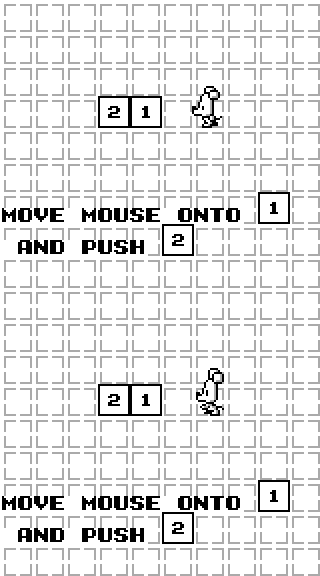
    The first level attempts to be an explicit tutorial.Q billion is a spatial reasoning game. You are presented with a puzzle in which there are several stacks of boxes. These boxes have numbers representing how tall these stacks are. Your goal is to reduce all stacks to 1 box high. However, there are limitations.
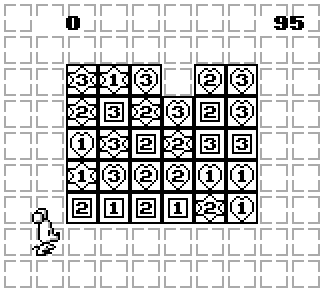
    First, you can only push a stack that is 1 box tall.

    Second, you can only topple a box that you are directly adjacent to; that is to say, if you want to topple the topmost box on a stack of 4 boxes, you must be sitting on a stack of 3 boxes next to it.

    Finally, you cannot topple a stack of boxes, only the topmost box in a stack.

    It gets a bit complicated after a while.There is an additional mechanic with magical disappearing blocks, but that is explained better in-game than I could possibly do here.

    All in all, this actually makes for a fun puzzle game. I haven't quite played anything else like it, which is a shame, as the game would play MUCH better with modern graphics (the game is presented with a top-down perspective, and the numbers on the boxes are quite nonsensical until you figure out the relationship between them). I'd love to play a sequel that looked like Picross 3D.

    1 player mode has a GAME A and GAME B. There is also an editor for constructing your own 1 player puzzles.

    GAME A presents you with a series of unique, one-room puzzles. Upon completing the 30th puzzle, you receive a password that unlocks 10 additional puzzles.

    Game B is weird.GAME B is a kind of versus mode that you play against the computer AI. Sorta. There are 5 "levels." Upon choosing a level, you are taken to a tic-tac-toe board, where you must choose 1 of the 9 squares, each of which represents a unique puzzle. If you solve the puzzle on this square quickly enough, you get to mark the board with your color. Your goal is to score 3 in a row, and then to win 5 "brackets." It's not all that exciting, except that you get 45 different puzzles out of it.

    I have not been able to play using the 2 player mode, which I assume requires a second copy of the game, two Game Boys, and a link cable.


    THOUGHTS:
    I consider this a hidden gem and a must-play for puzzler fans, particularly retro puzzler fans. This is quite fun and presents some very challenging puzzles.

    However, I must note that the visuals are absolutely terrible, and it may take quite some time to figure out what they are trying to depict. This game would be much better with a rotatable isometric viewpoint. I'd love to see a rerelease for iOS or another modern platform.

    The music is really obnoxious, too.


    LEVEL STRUCTURE:
    GAME A has 40 levels. The first 30 are immediately accessible and the last 10 are unlocked with a password (received upon completing the 30th puzzle).

    GAME B has 5 selectable "levels," each with 9 unique puzzles. No unlocking is necessary.

    All puzzles are non-randomized.


    CONTROLS:
    D-pad .... move cursor
    select ... cancel out of a menu (in some places)
    start .... choose menu item
    A ........ (in puzzle) push block
    B ........ (in puzzle) undo last move


    OPTIONS:
    In GAME A, you can choose slow, normal, or fast. This controls how responsive the game is to your button presses. I prefer fast.


    Quarth


    story | gameplay | my thoughts |
    level structure | controls | options

    BASIC INFO:
    Title ....... Quarth
    Players ..... 1-2
    Genre ....... shooter, puzzle
    Subgenre .... vertically-oriented shoot 'em up, tile removal
    Platform .... Arcade (1989), Famicom/NES (1990), Game Boy (1990), MSX2 (1990), Sharp X68000 (1990), mobile phone (2005), PS2 (2006), Wii Virtual Console (2010)


    STORY:
    There is a story to this, I bet. I'm sure it's a paper-thin, Arkanoid-esque story, but it's there. Hell if I know what it is. It's not explained in-game, I don't have the manual, and can't even find a copy online.


    GAMEPLAY:
    This is a hybrid between a vertically oriented shoot 'em up and tile removal block puzzler.

    You are a ship. You shoot things. Enemies advance on you in a set pattern throughout 27 levels.

    You shoot puzzle blocks. Your enemies are puzzle pieces formed from similarly shaped blocks. If you shoot at these pieces, your bullets will attach to them, changing their shape. Your goal is to change the shape of enemy pieces so that they form a rectangle, which destroys them.

    Score a lot of points to get some power-ups to help you on the more difficult levels. A lightning-bolt shaped power-up will destroy all pieces on screen, while an arrow-shaped power-up will temporarily pause the advancement of enemies so you can destroy them at a more leisurely pace. There's at least one other power-up whose use I haven't yet figured out.


    THOUGHTS:
    This game is weird and I feel weird after playing it.

    Did I just play a puzzle game? I love puzzle games! I love building up giant combos so I can blow up as many bricks as possible. It's like being a kid again, and making a giant tower of blocks so you can knock it down.

    Did I just play a 2D vertically oriented shoot-em-up? I thought I hated those. I hate the monotonous rote memorization of enemy patterns, and Quarth certainly has that. It's even worse than a normal scrolling shooter because all the blocking enemies blook blike the blame blocking blocks.

    Normal shooters at least let you mash the shoot button, which is nice and cathartic. But Quarth takes away this pleasure. Should you get trigger happy, blocks will stack up too far and crush you. For shame, Quarth! The ability to shooting indiscriminately is one of the few things I like about scrolling shooters!

    On the other hand, the enemy in Quarth produce no projectiles and move in a very simple pattern. They're perfectly harmless until, you know, they crush you. Their slow, inexorable, and perfectly predictable advance provides an excellent opportunity to set up a line of kills. It feels good, methodically dispatching each fearsome block in the most efficient manner possible.

    In the end, there is only 1 conclusion I can come to about the game: Quarth is weird. I don't know if I can say that like it, but I keep playing it.


    LEVEL STRUCTURE:
    There are 3 worlds, each with 9 levels. 1-1 is the easiest to beat while 3-9 is the hardest, with difficulty determined by the speed, density, and complexity of "enemy" advancement. You begin the game with access to all 27 levels.


    CONTROLS:
    D-pad .... move cursor; during a puzzle, press LEFT or RIGHT to move ship and press UP to speed up block advancement
    select ... select 1P or 2P match
    start .... choose menu item; pause/unpause
    A ........ shoot
    B ........ use powerup


    OPTIONS:
    There are 6 ships you can choose from before beginning play. This slightly affects the graphics of the puzzle, and changes the background music.


    1.09.2010

    Shanghai


    story | gameplay | my thoughts |
    level structure | controls | options

    BASIC INFO:
    Title ....... Shanghai (North America, Japan)
    Players ..... 1
    Genre ....... puzzle
    Subgenre .... matching, tile removal
    Platform .... Game Boy (1990)


    STORY:
    none


    GAMEPLAY:
    This is a bare-bones game of Mahjong solitaire. Upon starting a game, you are presented with a randomized puzzle in the classic "turtle" pattern.

    That's pretty much it.

    There is a nice piece of sprite artwork on the title screen, and a kickin' rad dragon when you complete a puzzle.


    THOUGHTS:
    Mahjong Solitaire in monochrome on a tiny screen is really hard on the eyes. Besides that, If you have a portable device that has internet connectivity, you already have this game.

    Besides that, there are many other versions of Mahjong Solitaire that are, frankly, much better. Shanghai Pocket (a dual mode Game Boy Color game) immediately springs to mind as being very similar to this game, but offering the advantages of color and multiple puzzle layouts. I also really enjoyed Mahjong Quest Expeditions for the DS, which has one less notable feature (you cannot change the tile type) but many new features, not the least of which is touchscreen functionality.


    LEVEL STRUCTURE:
    There is only one "level," and you are taken directly to it upon starting the game.


    CONTROLS:
    D-pad .... move cursor
    select ... menu
    start .... doesn't appear to do anything
    A ........ select
    B ........ deselect; cancel


    OPTIONS:
    In the menu you can access by pressing select, you have access to an OPTION menu and a BGM menu. The OPTION menu allows you to select HINT (shows you hints), PLAYBACK (undo), and FACE (allows you to change the tileset to symbols more familiar to Western audiences). BGM allows you to choose the background music from among 3 choices. Unfortunately, you cannot turn the music off.


    EXTRA NOTES:
    Apparently, the use of the name Shanghai in reference to Mahjong Solitaire is trademarked by Activision. Activision does appear in the game's opening credits ("original copyright (c)1986 Activision, Inc.)