story | gameplay | my thoughts
level structure | controls | options
BASIC INFO:
Title ....... Centipede (North America)
Players ..... 1-2
Genre ....... shooter
Subgenre .... 2D vertically-oriented
Platform .... Game Boy Color (1998)
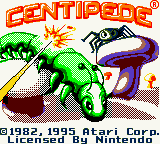 STORY:
Bugs're eating your delicious mushrooms. Are you just gonna let that slide?
GAMEPLAY:
This is, ultimately, a port of the original 1980 arcade game by Atari. I cannot tell how many degrees it has been removed from the original, however. It appears to be almost a direct copy of the Centipede port included in Arcade Classic 2: Centipede / Millipede. The only 2 differences between this and the Game Boy version is [1] the addition of color and [2] the removal of Millipede.
And so, the description here is almost word-for-word the description found on the other page.
I was very young when I played the original game and so I cannot accurately identify the differences between this version and the original, but I suspect the main differences lay in the addition of multiple 2-player modes. There are 3 kinds to choose from: alternate, compete, and team. Since this is a Game Boy Color game and I have only one cartridge (never mind one console and no link cable), I have not tested any of these, but the names are pretty descriptive.
In Centipede, you control a canister of pesticide and are tasked with destroying the centipedes invading your mushroom garden. Your minimalist screen is dotted with multicolored mushrooms, a centipede, and various other insect-themed enemies. Because bugs are so totally gross, you must avoid touching any of them. Fortunately, you can move your canister freely around the bottom 1/3 of the vertically-oriented screen (that is, across the entire width, as well as up and down 1/3 of the height of the screen).
The titular centipede is made of 9 segments, each of which must be destroyed individually. A mushroom is created if you destroy a segment. Note that if you destroy a middle segment, estranged segments will create a head (from one of the existing segments) and continue their merry way toward your destruction.
Each centipede descends from the top of the screen. Upon hitting a wall or normal mushroom, it drops closer to the player and switches directions. Upon reaching the bottom of the screen, it will start to move back up, but it will never leave the player area. If you fiddle-fart around, letting a centipede stay in the player area too long, 1-segment centipedes will be added to the player area until they kill you or you kill them.
Other enemies include spiders, fleas, and scorpions. Spiders move across the player area in a zig-zag pattern, eating mushrooms as they go. Fleas drop straight down from the top of the screen, quickly, planting mushrooms as they go. Scorpions move horizontally across the screen, slowly, and poison any mushrooms they touch; when a centipede touches a poisoned mushroom, it will move straight down to the player area.
There are a few more quirks to the gameplay, but that about covers the essentials. I would like to note that, for a game I used to play over 20 years ago, Centipede has aged surprisingly well.
THOUGHTS:
I think Centipede holds up great after all these years. If you are desperate to play Centipede on your Game Boy Color, this is certainly an adequate port of the game. The addition of color makes it superior to Arcade Classic 2: Centipede / Millipede, and the removal of Millipede is no great loss.
However, if you really want a portable copy of Centipede, you have some alternatives, as it was released a few times over the years. There are at least 2 iPod releases (Centipede; Atari's Greatest Hits), 1 PSP release (Atari Classics Evolved), 2 DS releases (Atari's Greatest Hits Vol 1; Retro Atari Classics), 2 Game Boy Advance releases (Atari Anthology; Centipede / Breakout / Warlords), and 2 Game Boy releases (the aforementioned Arcade Classic 2: Centipede / Millipede; Centipede). You can also play Centipede online for free at Atari's website. This list does not include DSiWare, PSP minis, bootlegs, homebrew or clones.
If you're a crazy arcade fan and have an extra $600 or so laying around (or already own an iPad), look into Atari sells Atari's Greatest Hits for iOS and the iCADE.
LEVEL STRUCTURE:
When you destroy an entire centipede, you proceed to the next level. As levels progress, more enemies spawn, enemies move faster, and centipedes spawn with more heads. A centipede with multiple heads is, in essence, multiple centipedes, and you'll find that each head will start moving in different directions.
CONTROLS:
D-pad .... move cursor; move pesticide can; choose difficulty level (left and right, only when menu is available)
select ... choose difficulty level (only when menu is available)
start .... confirm menu choice
A ........ spray pesticide
B ........ spray pesticide
OPTIONS:
Choose your difficulty from novice (start on level 1), standard (10), advanced (19), or expert (28).