Showing posts with label gbc. Show all posts

1.24.2010

Dragon Tales: Dragon Wings


story | gameplay | my thoughts |
level structure | controls | options

BASIC INFO:
Title ....... Dragon Tales: Dragon Wings
Players ..... 1
Genre ....... Platformer
Subgenre .... n/a
Platform .... Game Boy Color (2000)


Ohoho, puns.STORY:
You have had a flying accident while picking dragonberries. In order to be allowed to fly freely again, you must retake flying lessons at Quetzal's School in the Sky.


GAMEPLAY:
You are given explicit goals to accomplish on each of 20 stages. You have a very short timer for each stage. Berries extend your timer, and also serve to show you the way through the stage. Some berries must be eaten in a certain order because that's how eating works. Stages gradually become more complicated.


MY THOUGHTS:
Here is an early example of a typical, mediocre platformer based on a children's license.

I can't imagine what the game makers were thinking when they added the extremely restrictive timers. These timers completely prevent any sort of exploration, killing any sort of interest I may have had in the game.

This is a platformer: half the fun of a platformer is exploring the world it's in. Some gamers explore for the scenery, some for secrets, others to devise the best or most interesting path through the stage--but in the end, most of us who play a platformer will explore it. Not only that, but this is a platformer based in the world of a children's cartoon show. You'd think that the children playing this game might have extra reason to want to explore stages.

The controls are slippery and bouncy, making movement near walls and obstacles a pain. The music is too simple and harsh for its time and platform.

I'll be generous and call the graphics stylistic. The game gets credit for allowing the player to choose a male or female character.


LEVEL STRUCTURE:
There are 20 levels in total.


CONTROLS:
D-pad .... move character; move cursor
select ... advance dialogue
start .... pause/unpause; skip lesson intro
A ........ advance dialogue; enter door
B ........ breathe fire; drop item


OPTIONS:
Choose between a male or female character (Ord or Cassie). Choose between 3 difficulty settings (easy, medium, difficult).


1.20.2010

Hamtaro: Ham-Hams Unite!


story | gameplay | my thoughts |
level structure | controls | options

BASIC INFO:
Title ....... Hamtaro: Ham-Hams Unite! (North America, Europe); Tottoko Hamtaro 2: Hamchans Daishuugou Dechu (Japan)
Players ..... 1
Genre ....... RPG
Subgenre .... console-style
Platform .... Game Boy Color (2002)
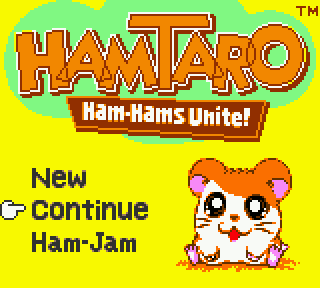
Title screen after saving
STORY:
Boss has a surprise for all the Ham-hams, and he's just about ready to show them. As he puts the finishing touches on his surprise, he asks Hamtaro to go fetch all the Ham-hams back to the Clubhouse.


GAMEPLAY:
Your goal is to locate the hamsters who live in the clubhouse and get them to go to the Clubhouse.
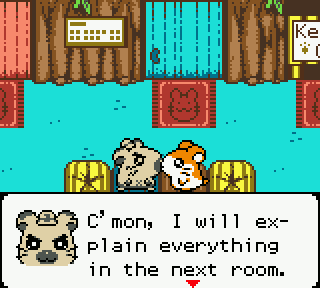
Boss, after fulfilling his role as Captain Exposition, immediately puts on Mr. Manual's hat.Finding the hamsters can be problematic in and of itself, especially if you aren't particularly familiar with the cartoon series this game is based off of. You are given their names and general location in the world. From there, locating your friends is standard RPG fare: explore, investigate strange-looking places, solve puzzles, fetch quest, talk to and/or bribe necessary characters. That sort of thing.

After you have located a character, convincing them to go back is the next step. While your friends seem generally helpful and accommodating, they each have various reasons to be too preoccupied or distressed to listen to you. You have to deal with whatever it is that is bothering them before they will listen to you and go back to the Clubhouse. Again, this involves the standard RPG fare of exploring, investigating strange-looking places, solving puzzles, fetch questing, talking to and/or bribing necessary characters, and so on.
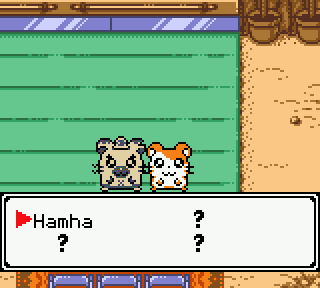
Baby's first Ham-chat.A central element to the gameplay are Ham-chats. Ham-chat is, in essence, hamster jargon. If you want to advance the plot, you'd better learn to say "bizzaroo," because these snobby hamsters won't respond to such a plebian word as "strange." You will start the game off knowing 10 or so Ham-chat words and from there learn up to 82 more. You'll learn Ham-chats from unavoidable plot events, talking with NPCs, and side quests.

When speaking with other hamsters, you are prompted to choose from several Ham-chats (or question marks, representing Ham-chats you haven't learned but could use if you had). Which Ham-chat you use dictates how the hamster (or other creature) you are talking to responds. Choosing the "wrong" Ham-chat never ruins the game, but can often be entertaining, as you can insult, bite, or --in one case-- attempt to urinate on your conversation partner.

There are various optional elements to the gameplay. Throughout the game, you can buy clothing and accessories; in the Clubhouse, you can "dress-up" Hamtaro, which changes his appearance at the title screen. There are also "Ham-Jams" which you can collect and edit. These are short songs to which Hamtaro "dances".

Despite being an RPG, there are no battles in this game. There is one minigame that is mandatory, but not very hard.

The game auto-saves. You can only keep one save at a time.

Upon completing the main plot of the game, there is post-plot content. You can learn a few final Ham-chats and explore the world to gather some stars that have fallen.


THOUGHTS:
Despite being based on a children's cartoon license, this is a surprisingly fun game. I'd consider this a jRPG despite its lack of battles. I feel that the game is complete without battles, but others may disagree.

Puns abound.The game is genuinely funny. It focuses on kid-friendly humor like puns and wordplay. Logical contradictions are sometimes introduced as an element of humor. Reactions and expressions of characters are exaggerated for comic effect. You are given the option to interact with characters and scenery in multiple ways that product no plot effect, but produce entertaining scenes.

Hamtaro: Ham-Hams Unite embraces a light-hearted tone with a one-dimensional story and characters with simple and forthright complaints. It's a far cry from the typical jRPG, whose multilayered story must be deciphered by the collaborative efforts of a forum full of fans playing the game in multiple languages and using supplemental written material. The little cartoon hamsters of Ham-Hams Unite have simple and sometimes childish needs, but let's face it--those are much easier for a gamer to relate to than the angst of some prophesied hero whose family was slaughtered by the evil alien empire.

Another thing I enjoyed was that much of the game was non-linear. Now, some actions need to be completed in order to open access to the next section. However, some sections open simultaneously, and of course, once multiple sections are open, it is up to you to decide where to go and what to do. It feels very open in a way that most jRPGs don't.


LEVEL STRUCTURE:
There are 7 locations in the game. 1 location is the Clubhouse, where exposition occurs and hints can be obtained. If you get bored with plot, you can come to the Clubhouse and mess around with superfluous cute things the game put in for you.

The other 6 locations are the "levels" where most of the game actually occurs. When you begin the game, you have access to only one of these locations, Acorn Shrine. As you progress the plot (demonstrating some basic competency in the game), you gain access to more areas.

If, at any time, you learn all the Ham-chats in a level, the sunflower icon that marks it will begin to spin.


CONTROLS:
D-pad .... move cursor or character
select ... brind up Items menu; sort Dictionary
start .... access Dictionary menu; close Dictionary menu
A ........ bring up Ham-chat menu; select option from any menu
B ........ exit any menu; hold down to run


OPTIONS:
You can change the appearance of the title screen by dressing up Hamtaro in-game. You can edit Ham-Jams (optional mini-game).

1.06.2010

V.I.P.


story | gameplay | my thoughts |
level structure | controls | options

BASIC INFO:
Title ....... V.I.P. (North America, Europe)
Players ..... 1
Genre ....... multiple
Subgenre .... multiple
Platform .... Game Boy Color (2001)


VIPSTORY:
An actor has been nominated to receive an award, but his fiancee has informed the press that he's gone missing. You and your buddies have been put on the case. Not only do you need to find the missing person, but you need to do so in time for him to catch the awards ceremony tonight.


GAMEPLAY:
This game is composed of multiple segments, each of which is its own genre.

Throughout the game, you must watch your health and lives. Your health is represented by 5 hearts, with any damage taking off 1 heart. Lose all your hearts and you will lose a life. You can stock a total of 9 extra lives. In addition to items that restore health and grant extra lives, there are also shields that grant invincibility in all parts of the game.

There are 3 pseudo-racing segments. Your goal is to reach the end of a set map without losing your lives. Working against you are environmental hazards that will take away your health (other cars that can crash into you, sandpits that will turn you over) and your limited fuel. If you run out of fuel, you lose a life. Fortunately, there are plentiful fuel refills (health, and life) scattered along the road.

A 4th pseudo-racing segment is similar to the above, only it is vastly simplified by the removal of fuel. You are, coincidentally, driving a boat.

There are 2 skating segments. Again, your goal is to reach the end of a set map without losing your lives. Working against you are banana peels, irate kiosk staffers, balloons, and the dreaded stairs. Skate forward and jump over these obstacles to reach your goal. If you want to get fancy, grab some balloons while you're at it.

There are 4 shooter segments, though they are equally divided among two different genres. In two segments, you guide a character on-foot across a standard "full of baddies" map. This is done in a top-down, 3rd person perspective. You cannot run out of bullets, but you can collect, use, and run out of grenades. The other two segments are standard vertically scrolling shooters, complete with ammo upgrades.

Finally, there are 4 platforming sections (2 of which are consecutive). The platforming sections are fairly standard run and jump/gun, with baddies to shoot and all that whatnot. You can run out of ammo only in the platforming sections; consequentially, there are items which restore you ammo. If you do run out of ammo, you are restricted to close-range combat using your purse.


THOUGHTS:
I enjoyed this game. It's not hard by any stretch of the imagination, mind you, but I did enjoy exploring stages and getting to see what the next stage was like.

I also experienced a bit of "baby's first shooter/racer". I typically avoid those genres, and I can't say I cared much for the racing segments in this game. However, the scrolling shooter segments were entertaining, and I have a greater interest in "real" scrolling shooters now.


LEVEL STRUCTURE:
14 named segments. You can obtain passwords.


CONTROLS:
D-pad .... move cursor; move character
select ...
start .... pause
A ........ confirm/enter/choose
B ........ cancel


OPTIONS:
Choose to play in English, Spanish, or French (a screenshot on Mobygames suggest that the EU version may also offer Italian and German, but those are not options on my NA copy). Turn music on or off. Turn sound effects on or off.


EXTRA NOTES:
Based off an "action/comedy-drama" TV show aired from 1998 to 2002.

There are V.I.P. games for other platforms, but they do not appear to be the same as this game. The game for the GBA is, according to Mobygames, "a side-scroller with 8 levels", while the PS2/PC game is a fighting game.