Showing posts with label 3pov. Show all posts

1.27.2010

Adventure Island II: Aliens in Paradise


story | gameplay | thoughts |
level structure | controls | options

BASIC INFO:
Title ....... Adventure Island II: Aliens in Paradise (North America), Takahashi Meijin no Boukenjima III (Japan)
Players ..... 1
Genre ....... platformer
Subgenre .... side-scroller
Platform .... NES (1992), Game Boy (1993)


A dashing hero, complete with potbelly.STORY:
Your girlfriend has been kidnapped by aliens. Well?


GAMEPLAY:
Each level consists of a short side-scroller segment. Almost every level scrolls from left to right, and as you scroll parts of the level off to the left of the screen, those parts become inaccessible. A few levels also move up-down.

Enemies and environmental hazards are the most familiar difficulties preventing you (Master Higgins) from completing a level. Enemies can be avoided or defeated using a weapon, which you can obtain from eggs scattered about levels. Environmental hazards, such as pits or fire, typically must be avoided.

You've found a large, yummy roast leg of yak!Hunger, a reappearing element in the Adventure Island games, is another difficulty that must be contended with. You have an energy meter at the bottom of the screen which functions a little like a timer, in that it steadily decreases and you will lose a life if you allow it to completely empty. However, unlike most timers of the era, the energy meter can be refilled by eating food. Fruit (which refills your meter slightly) appears frequently, while meat (which refills it completely) may appear once in a stage, in a hidden or difficult to reach area.

Vehicles speed up your progress through a level, helping you avoid a death-by-hunger. A skateboard is available, as are 5 different dinosaur companions. 4 of these dinosaurs are uniquely suited for different terrain (lava, ice, water, air) and give you access to a special attack, 1 per dinosaur. The 5th dinosaur can barrel through nearly any enemy or obstacle.
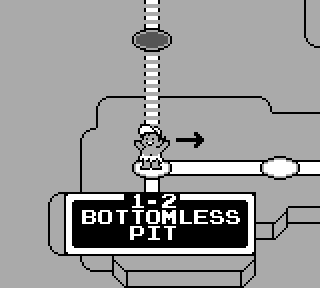
Bottomless Pit? I freaking LOVE bottomless pits!Levels are arranged on a world map, allowing for back-tracking and replaying previous levels. A surprising number of secrets are hidden on these very short levels, from bonus stages to warps to simple power-ups. Keep an eye on the terrain directly behind you, and don't feel bad about randomly attacking walls.

You cannot save, but a unique password is provided upon completion of each world. So long as you do not turn off or reset the console, you have infinite continues that remember the level on which you died and the number of items you had at the time of death.


THOUGHTS:
This is a classic example of the sort of absurdity that was standard fare in the 80s and early 90s. The plot, such as you can infer from the animations and sprites, is ridiculous. The setting is a bizarre mishmash of whatever seems cool from other settings (dinosaurs! skateboards! aliens!). The mood, as set by the graphics and music, is cheerful and cartoony, strictly at odds with the constant threat of death from hunger, floating skulls, and eggplants. And, of course, your character dies if he so much as brushes against a vile enemy--like a bird.

I loved the days when this kind of stuff was standard.

The game is short and easy if you want it to be short and easy. If you want more content, that content is there to be found. The game won't make you find it, though, and the only reward for finding it is, well, finding it. If you want achievements or other external motivation to get the most of your game, you will probably not enjoy Adventure Island II.

I seem to recall reading an opinion piece where a gamer talked about how they liked the series's hunger mechanic and the sense of urgency it added to the game. At the time, I scoffed at the idea, but now I'm inclined to agree. While I still like being given the time to explore a level at leisure, the levels in this game are--as mentioned--short. I can get a sense of accomplishment from successfully completing a level without running out of food, and then immediately replay the same level for secrets without feeling like my time has been wasted. This provides for a sort of "one more go" experience missing from the platformers with huge, sprawling levels that take a substantial time investment to explore.


LEVEL STRUCTURE:
[World #]-[Level # or LETTER]
There are 8 worlds.

Each world has levels 1 through 6 and a level A and B. You do not need to complete all 8 levels to reach the next world.

The #-6 level of each world has a boss at its end. Completing this level opens up the next world. You can frequently warp past levels by finding secret areas.


CONTROLS:
D-pad .... move cursor, move character
select ... exit out of a level from the item selection screen
start .... pause/unpause
A ........ jump, swim; choose item from item selection screen
B ........ attack; move more quickly (run, fly); remove items from item selection screen


OPTIONS:
None to speak of. However, there are "secret" passwords that will allow you to start off the game with variables changed. 1984 seems to be the "ultimate" password which starts you off with 99 lives, 99 of all items, and all levels unlocked, but I don't know the significance of the date.


Arcade Classic 2: Centipede / Millipede


story | gameplay | thoughts |
level structure | controls | options | credits

BASIC INFO:
Title ....... Arcade Classic 2: Centipede / Millipede (North America)
Players ..... 1-2
Genre ....... shooter
Subgenre .... vertically oriented shoot 'em up
Platform .... Game Boy (1995)


Two arcade games on one cartridge? Now that's technology!STORY:
Bugs are ransacking your mushroom garden.


GAMEPLAY:
These are slightly modified ports of the original 1980 (Centipede) and 1982 (Millipede) Atari arcade games. How much is modified, I cannot say--I don't remember playing the original arcade versions. I rather suspect the main difference is the addition of a 2-player mode in Millipede and three 2-player modes in Centipede (alternate, compete, and team).

Centipede and Millipede are remarkably similar games. In both games, you control a canister of pesticide and are tasked with protecting your mushroom garden from various invasive pests. Your minimalist screen is dotted with mushrooms, a centipede (or millipede), and various other creepy-crawly themed enemies. Because bugs are so totally gross, you must avoid touching any of them, lest you lose a life. Fortunately, you can move your canister freely around the bottom 1/3 of the vertically-oriented screen (that is, across the entire width, as well as up and down 1/3 of the height of the screen).

The titular centipede is made of 9 segments (the millipede is made of 10, and gets larger as levels progress). Each segment must be destroyed individually. If you destroy a middle segment, you will in effect create two independently moving centipedes (millipedes) as the estranged segment will create a head from one of its existing segments. Just like in real life.

The 'pede spawns at the top of the screen and moves to the left or right and, upon hitting a wall or normal mushroom, it drops down a row and switches directions. Upon reaching the bottom of the screen, it will start to move back up, but it will never leave the player area. If you fiddle-fart around, letting a 'pede stay in the player area too long, 1-segment 'pedes will be added to the player area until they kill you or you kill them.

In Centipede, other enemies include spiders, fleas, and scorpions. Spiders move across the player area in a zig-zag pattern, eating mushrooms as they go. Fleas drop straight down from the top of the screen, quickly, planting mushrooms as they go. Scorpions move horizontally across the screen, slowly, and poison any mushrooms they touch; when a centipede touches a poisoned mushroom, it will move straight down to the player area.

In Millipede, other enemies include spiders, earwigs, bees, dragonflies, inchworms, beetles, and mosquitos. The spider works the same as it did in Centipede, although there are more of them on the screen at a single time. The earwigs and bees work just like Centipede's scorpion and fleas, respectively. Dragonflies move about in a zigzag pattern, leaving mushrooms in their wake; inchworms move rapidly across the screen but will slow enemies if you manage to shoot them; beetles go straight to the player area to be annoying and, if left alive, will turn mushrooms into indestructible dandelions; and mosquitos will bounce around annoyingly and, if shot, will move everything up a row.

There are two more notable elements in Millipede. First, the screen scrolls. When you kill a millipede, everything on the screen scrolls down a row. This is handy for getting rid of dandelions and poisoned mushrooms. It also gives you a steady supply of the other notable element, the DDT item, which scrolls in from the top of the screen. If you shoot a box of DDT, a cloud will appear that kills any enemy or mushroom caught in it. It sticks around for a few seconds, so you might have an entire millipede walk into it.

There are a few more quirks to the play of these games, but that about covers the essentials.


THOUGHTS:
I think these 2 games hold up surprisingly well. I can still get 5 to 30 minutes of play from them, trying to do just a little better than last time. I prefer Centipede over Millipede--even though Millipede should theoretically be more interesting due to having more elements, Centipede has that sort of Tetris-like simplicity that lends to a sort of meditative play.

However, the Game Boy ports are...well, not the best. Better to play the official browser version (Centipede, Millipede) or any of the various ports to Nintendo, Sony, Sega, or Apple handhelds.


LEVEL STRUCTURE:
When you destroy an entire centipede (or millipede), you proceed to the next level. As levels progress, more enemies spawn, enemies move faster, and centipedes (or millipedes) spawn with more heads. In millipede, every few levels you are preiodically treated to a "bonus round" of sorts, where you are faced with a swarm of non-millipede enemies. You can score many points here, if you don't get killed.


CONTROLS:
D-pad .... move cursor or pesticide can (both games); choose difficulty level (Centipede only; only when menu is available); change score (Millipede only, only when menu is available)
select ... choose difficulty level (Centipede only; only when menu is available)
start .... confirm menu choice (both games)
A ........ spray pesticide (both games)
B ........ spray pesticide (both games)


OPTIONS:
Centipede: Before starting a game, you can choose your difficulty from novice (start on level 1), standard (10), advanced (19), or expert (28).
Millipede: Before starting a game, you can change the number of points you start off with (between 0 and 100k, in intervals of 10k). This effects what level you start off on. You can start off as high as level 20 (100k points) or as low as level 1 (0 points). Furthermore, if you score higher than 100k points, when you restart a game, you can start off near that score.


1.26.2010

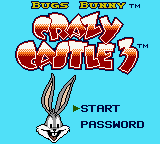
Bug's Bunny: Crazy Castle 3


story | gameplay | thoughts |
level structure | controls | options

BASIC INFO:
Title ....... Bug's Bunny: Crazy Castle 3 (North America, Europe, Japan); Soreike! Kid: Go! Go! Kid (Japan)
Players ..... 1
Genre ....... platform
Sub-genre ... puzzle platformer
Platform .... Game Boy (1999, Japan), Game Boy Color (1999)


Clever alt text here.STORY:
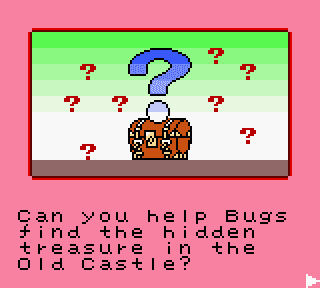
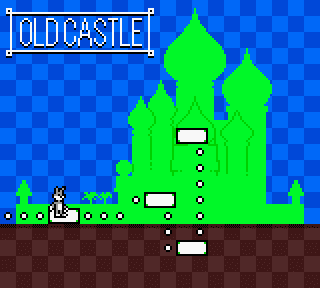
Bugs Bunny is searching through Old Castle for a great treasure he read about in a book. His friends are under a spell and are trying to stop him.


GAMEPLAY:
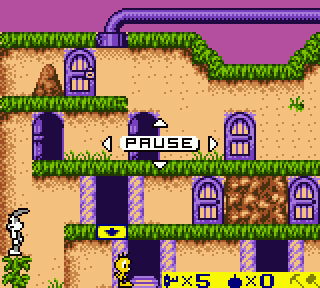
You can examine the entire level when the game is paused.Your goal in Bugs Bunny: Crazy Castle 3 is to clear all 61 stages of the Old Castle. To clear a stage, you must collect the 8 keys scattered about, then proceed to the locked door which leads to the next stage.
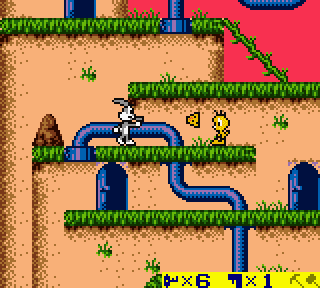
Simple enough, but there are other characters from the Looney Tunes universe wandering around on screen, and a touch from them is fatal. Furthermore, many will actively attempt to stop your quest...with varying degrees of effectiveness. It is easy enough to avoid the ones who walk very slowly back and forth across a platform. On the other hand, others will chase you throughout the stage, unless you disable them.

In the end, the blame is pinned on the puddy tat.You can disable your enemies/friends. Or, more accurately, you can blow up, crush, and shoot them with the various items you find laying about (bombs, anvils, and very lethal cork pop guns). Use these items well, and your pursuers will be destroyed with a comic puff of air, leaving you to explore the area at a slightly more leisurely pace.
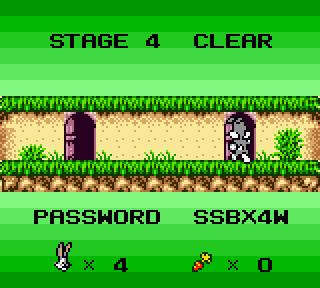
As levels become progressively more complex, you can often simply outrun your enemies, using the many stairs, ladders, pipes, vines, ropes, trampolines, and other such whatnot to get around the level. But where's the fun in that?

Complete level, receive password.The game doesn't save your progress, but it does give you passwords. A password saves not just the level you are on, but it also seems to save the number of lives you've earned. Continues in the game are infinite. Additionally, you earn a life every time you complete a stage successfully, find 1ups in stages, and earn 1ups by collecting carrot icons.


THOUGHTS:
Thou must.I've heard a lot of praise for the Crazy Castle series, and I have fond memories of Kemco's Bugs Bunny Birthday Blowout for the NES -- a straightforward and simple action-based platformer that I played with my brothers. This game seemed like a winner: I'm a fan of puzzle platformers, I'd had a good experience with the developer making a similar game, and retro gamers agreed it was a good game from a good series. I was happy to get a copy.
I was incredibly disappointed the first time I played it. I played the first 2 levels and was, well, bored. I set the game aside down and didn't come back to it again for months.

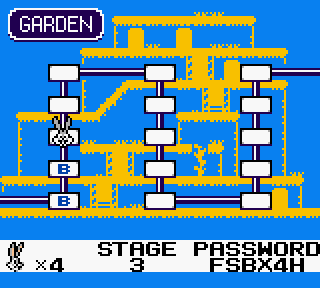
The B stands for 'Boring'.I did come back to the game, fortunately. I'm not going to lie, the first 5 stages are terrible -- perhaps less so if you are inexperienced with the genre. But after slogging through those first 5 dull stages, the game starts to get interesting. The levels expand in size and scope, giving you room to decide how you want to solve them. New puzzle elements are often brought into play, and a new set of enemies are introduced in each world (although they differ only in appearance).

The last levels are huge, sprawling affairs that seem downright overwhelming in scope. However, as you play, a solution falls into place little by little. Finally solving one of these gigantic puzzles gives an intense feeling of satisfaction.


This castle is old.LEVEL STRUCTURE:
[world NAME] [stage #]

There are 4 worlds (the Garden, the Hall, the Basement, and the Treasury) that have 15 stages each. Upon completing the 60th stage, you proceed to the final, 61st stage.


CONTROLS:
D-pad .... move left or right (left or right); use doors, stairs, vines, pipes, ladders, and so on (up or down)
select ... nothing
start .... pause, unpause
A ........ use items, use switches
B ........ use items


OPTIONS:
None.


EXTRA NOTES:
Based on the Looney Tunes cartoon show.

There are 7 Crazy Castle titles and 1 compilation (to my knowledge, the FDS/NES, Game Boy, and Mobile games under the title "Bugs Bunny Crazy Castle" are not ports but actually different games). Two of the Crazy Castle titles are, in Japan, Mickey Mouse titles, which has its own series (5 releases total).

The Crazy Castle titles are as follows:
The Mickey Mouse titles are:


Wikipedia thinks that The Bugs Bunny Birthday Blowout (1990 FDS/NES) and Mickey's Dangerous Chase (1991-3 GB) are also part of the Crazy Castle series.


1.25.2010

Centipede


story | gameplay | my thoughts
level structure | controls | options

BASIC INFO:
Title ....... Centipede (North America)
Players ..... 1-2
Genre ....... shooter
Subgenre .... 2D vertically-oriented
Platform .... Game Boy Color (1998)


It's more likely than you think.STORY:
Bugs're eating your delicious mushrooms. Are you just gonna let that slide?


GAMEPLAY:
This is, ultimately, a port of the original 1980 arcade game by Atari. I cannot tell how many degrees it has been removed from the original, however. It appears to be almost a direct copy of the Centipede port included in Arcade Classic 2: Centipede / Millipede. The only 2 differences between this and the Game Boy version is [1] the addition of color and [2] the removal of Millipede.

And so, the description here is almost word-for-word the description found on the other page.

I was very young when I played the original game and so I cannot accurately identify the differences between this version and the original, but I suspect the main differences lay in the addition of multiple 2-player modes. There are 3 kinds to choose from: alternate, compete, and team. Since this is a Game Boy Color game and I have only one cartridge (never mind one console and no link cable), I have not tested any of these, but the names are pretty descriptive.

In Centipede, you control a canister of pesticide and are tasked with destroying the centipedes invading your mushroom garden. Your minimalist screen is dotted with multicolored mushrooms, a centipede, and various other insect-themed enemies. Because bugs are so totally gross, you must avoid touching any of them. Fortunately, you can move your canister freely around the bottom 1/3 of the vertically-oriented screen (that is, across the entire width, as well as up and down 1/3 of the height of the screen).

The titular centipede is made of 9 segments, each of which must be destroyed individually. A mushroom is created if you destroy a segment. Note that if you destroy a middle segment, estranged segments will create a head (from one of the existing segments) and continue their merry way toward your destruction.

Each centipede descends from the top of the screen. Upon hitting a wall or normal mushroom, it drops closer to the player and switches directions. Upon reaching the bottom of the screen, it will start to move back up, but it will never leave the player area. If you fiddle-fart around, letting a centipede stay in the player area too long, 1-segment centipedes will be added to the player area until they kill you or you kill them.

Other enemies include spiders, fleas, and scorpions. Spiders move across the player area in a zig-zag pattern, eating mushrooms as they go. Fleas drop straight down from the top of the screen, quickly, planting mushrooms as they go. Scorpions move horizontally across the screen, slowly, and poison any mushrooms they touch; when a centipede touches a poisoned mushroom, it will move straight down to the player area.

There are a few more quirks to the gameplay, but that about covers the essentials. I would like to note that, for a game I used to play over 20 years ago, Centipede has aged surprisingly well.


THOUGHTS:
I think Centipede holds up great after all these years. If you are desperate to play Centipede on your Game Boy Color, this is certainly an adequate port of the game. The addition of color makes it superior to Arcade Classic 2: Centipede / Millipede, and the removal of Millipede is no great loss.

However, if you really want a portable copy of Centipede, you have some alternatives, as it was released a few times over the years. There are at least 2 iPod releases (Centipede; Atari's Greatest Hits), 1 PSP release (Atari Classics Evolved), 2 DS releases (Atari's Greatest Hits Vol 1; Retro Atari Classics), 2 Game Boy Advance releases (Atari Anthology; Centipede / Breakout / Warlords), and 2 Game Boy releases (the aforementioned Arcade Classic 2: Centipede / Millipede; Centipede). You can also play Centipede online for free at Atari's website. This list does not include DSiWare, PSP minis, bootlegs, homebrew or clones.

If you're a crazy arcade fan and have an extra $600 or so laying around (or already own an iPad), look into Atari sells Atari's Greatest Hits for iOS and the iCADE.


LEVEL STRUCTURE:
When you destroy an entire centipede, you proceed to the next level. As levels progress, more enemies spawn, enemies move faster, and centipedes spawn with more heads. A centipede with multiple heads is, in essence, multiple centipedes, and you'll find that each head will start moving in different directions.


CONTROLS:
D-pad .... move cursor; move pesticide can; choose difficulty level (left and right, only when menu is available)
select ... choose difficulty level (only when menu is available)
start .... confirm menu choice
A ........ spray pesticide
B ........ spray pesticide


OPTIONS:
Choose your difficulty from novice (start on level 1), standard (10), advanced (19), or expert (28).


Cyraid


story | gameplay | my thoughts
level structure | controls | options

BASIC INFO:
Title ....... Cyraid (North America); Bakuretsu Senshi Warrior (Japan)
Players ..... 1-2
Genre ....... platform
Subgenre .... puzzle platformer
Platform .... Game Boy (1)


Dunno what's up with the space theme.STORY:
Natasia has been kidnapped. Save her, Warrior and/or Fighter!


GAMEPLAY:
Cyraid is a platformer with heavy puzzle elements. Each stage is presented on a single screen and each screen is filled with monsters, ladders, and various kinds of blocks. Each stage has about 6 blocks (give or take) that are labeled E.

By simultaneously pressing A and the D-pad, you can kick. Given the correct circumstances, you can use kicking to modify everything on the screen. You can destroy blocks, kill enemies, and kick around ladders. Your goal on each stage is to use your elite kicking skills to reach and open all of the E blocks and collect (or destroy) the capsules that drop out from them.

Every couple minutes, a large, ball-shaped monster appears from some fixed spot on the wall. Any blocks you have destroyed have a chance of reappearing as it stomps about shaking the screen. This can be useful if you find that you have destroyed a block you need to reach a certain area. However, if you are standing on the same spot a block reappears in, you will die instantly.

Destroying blocks sometimes reveals extra lives and powerups. An x-shaped power-up stacks to give you useful abilities like speed and jumping. This allows you to take shortcuts on stages and finish them up more quickly, but you'll lose them if you die.

The final level of each world features a boss. Boss levels remind me of fighting Bowser in Super Mario Bros., in that you must dodge the attacks of the boss monster in order to reach a button that destroys the monster.


THOUGHTS:
I love this game. I'm not sure I can explain why in any satisfying way. It's hard to get past the "OmigoshCyraidSQUEE!"

Ultimately, it comes down to the following combination of facts:
[1] I love puzzle games
[2] Cyraid is a puzzle game
[3] I find Cyraid to be challenging, but not brutally hard

I especially appreciate that Cyraid is an action puzzler. It supports different play styles, which I'll often cycle through. You can be the gamer who sits at the beginning of the stage, not moving until you've planned out every move--and when you get tired of that, next stage you can pick the nearest E-block to open and think on the move. Either way, you'll probably die due to something unforeseen, but you'll be better prepared for the next time you try the stage!

As you progress in the game, you'll accumulate useful power-ups like jumping and speed. You'll pass through levels with these power-ups, not knowing how to beat them otherwise. Learning how to complete levels with power-ups is challenging in its own right, but learning how to do so without power-ups is also quite fun. While perhaps not everyone interested in Cyraid will be interested in this "hard mode," many of us who are drawn to Cyraid will also be drawn to such a challenge.

The simple looks of Cyraid are perfect for its nature. The graphics accomplish what they need to. The visuals aren't very detailed, and perhaps you can't tell what an enemy is supposed to be...but, if you are at all familiar with video games, you know it's an enemy and will hurt you if you touch it. Furthermore, each sprite is distinct from the other, and nothing is so distracting that you will get startled and make a stupid mistake.


LEVEL STRUCTURE:
[world #] [stage #]

There are 4 worlds. World 1 has 8 stages, world 2 has 21 stages, and world 3 has 27 stages. I do not know how many stages world 4 has. Sometimes stages can be skipped. You can start at the beginning of any world by using a password: DRAGON (2), SLAYER (3), or RUGGER (4).


CONTROLS:
D-pad ...................... move your cursor; move your character
select ..................... ??
start ...................... pause
A .......................... shoot lasers (only if you have "-5-" at the top of your screen AND at least one black bar)
B .......................... jump (if you have "-4-" or "-5-" at the top of your screen)
A + D-pad simultaneously .... kick stuff
select + B simultaneously ... lose a life and start the level over


OPTIONS:
None.


CREDITS:
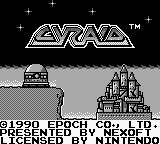
on title screen:
    CYRAID™
    ©1990 EPOCH CO., LTD.
    PRESENTED BY NEXOFT
    LICENSED BY NINTENDO


1.24.2010

Dr. Franken


story | gameplay | my thoughts |
level structure | controls | options

BASIC INFO:
Title ....... Dr. Franken
Players ..... 1
Genre ....... Platform
Subgenre .... Amble-and-jump with puzzle elements
Platform .... Game Boy (1992)


One of the least inspiring title screens.STORY:
You are a 7 foot tall masterpiece creation of the Dr. Frankenbone! Or, at least, you were. Now you are a 3 foot midget, thanks to the doctor's other, less masterful creations. These jealous and wicked creatures have also dismantled your beloved girlfriend, Bitsy, and scattered her parts about the castle. It is your boyfriendly duty to gather her pieces and put her back together again, so that you can return to your grotesquely reanimated snuggling.


GAMEPLAY:
You must gather the 10 parts of Bitsy's body; the Body Plan that lets you know how to assemble her; Thread with which to sew her together; and a Conductor and a Power Lever in order to operate the machine that will bring her to life.

In order to obtain these 14 items, you must gain access to all of the castle. In order to do that, you must collect several other items. These include (but are not limited to) various keys, levers, and dynamite. Upon obtaining an item, you typically have no idea where to go next to obtain the next item.

While exploring the castle, you must beware of various enemies. While you can shoot lightning bolts by pressing B, not all enemies can be defeated in this (or any) manner. Hazards, such as flames, falling objects, barrels, and spikes must also be carefully navigated.

You have a health meter, which can be viewed in the select menu and restored by grabbing Lightning Bolt items in various rooms or at the power outlet on Floor 4. You can save your game, but the save disappears upon reseting or turning off the console; fortunately, saving your game also provides a password.


THOUGHTS:
Dr. Franken reminds me of a very rudimentary Metroidvania. The primary and detrimental differences are that: [1] the entirety of the map is given to at the beginning of the game, and [2] upon obtaining an item that opens up a new part of the map, you are not given any sort of hint as to where the new area is.

Point 1 quickly becomes annoying as you forget where you have and have not yet explored. In Castlevania, if I get lost after obtaining a new item or ability, I can simply check my map and see where the dead ends are--and I know one of those is where I need to go next.

Point 2 is just plain bad design. Upon being given a new item that opens up access to a new area, the only clue you have as to where that new area begins is the item name. While sometimes, the item name is sufficient (the Dynamite, for instance, led me straight to the giant pile of TNT I had previously had to jump over), most times it is not. For example, I wandered almost the entirety of the castle before discovering that the Armory Key opened up a new door under a random set of armor. Mind you, sets of armor are all over the frikkin' castle--nevermind that I was expecting one of the random locked doors of the castle to be the door to an armory.

Don't get me wrong, I like the game. It's quaint design flaws are something I, personally, can appreciate...at least in an 18-year-old game that I barely paid $2 for. I would really like to see this series revived for modern handhelds, in full-blown 2D Metroidvania style.


LEVEL STRUCTURE:
We don't need no stinkin' levels.


CONTROLS:
D-pad .... move cursor; move character
select ... bring up or close menu
start .... bring up or close map
A ........ jump
B ........ use weapon


OPTIONS:
The music can be turned on or off in the select menu.


Dragon Tales: Dragon Wings


story | gameplay | my thoughts |
level structure | controls | options

BASIC INFO:
Title ....... Dragon Tales: Dragon Wings
Players ..... 1
Genre ....... Platformer
Subgenre .... n/a
Platform .... Game Boy Color (2000)


Ohoho, puns.STORY:
You have had a flying accident while picking dragonberries. In order to be allowed to fly freely again, you must retake flying lessons at Quetzal's School in the Sky.


GAMEPLAY:
You are given explicit goals to accomplish on each of 20 stages. You have a very short timer for each stage. Berries extend your timer, and also serve to show you the way through the stage. Some berries must be eaten in a certain order because that's how eating works. Stages gradually become more complicated.


MY THOUGHTS:
Here is an early example of a typical, mediocre platformer based on a children's license.

I can't imagine what the game makers were thinking when they added the extremely restrictive timers. These timers completely prevent any sort of exploration, killing any sort of interest I may have had in the game.

This is a platformer: half the fun of a platformer is exploring the world it's in. Some gamers explore for the scenery, some for secrets, others to devise the best or most interesting path through the stage--but in the end, most of us who play a platformer will explore it. Not only that, but this is a platformer based in the world of a children's cartoon show. You'd think that the children playing this game might have extra reason to want to explore stages.

The controls are slippery and bouncy, making movement near walls and obstacles a pain. The music is too simple and harsh for its time and platform.

I'll be generous and call the graphics stylistic. The game gets credit for allowing the player to choose a male or female character.


LEVEL STRUCTURE:
There are 20 levels in total.


CONTROLS:
D-pad .... move character; move cursor
select ... advance dialogue
start .... pause/unpause; skip lesson intro
A ........ advance dialogue; enter door
B ........ breathe fire; drop item


OPTIONS:
Choose between a male or female character (Ord or Cassie). Choose between 3 difficulty settings (easy, medium, difficult).


1.20.2010

Hamtaro: Ham-Hams Unite!


story | gameplay | my thoughts |
level structure | controls | options

BASIC INFO:
Title ....... Hamtaro: Ham-Hams Unite! (North America, Europe); Tottoko Hamtaro 2: Hamchans Daishuugou Dechu (Japan)
Players ..... 1
Genre ....... RPG
Subgenre .... console-style
Platform .... Game Boy Color (2002)

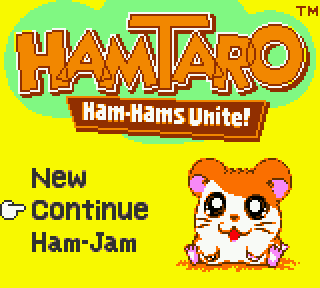
Title screen after saving
STORY:
Boss has a surprise for all the Ham-hams, and he's just about ready to show them. As he puts the finishing touches on his surprise, he asks Hamtaro to go fetch all the Ham-hams back to the Clubhouse.


GAMEPLAY:
Your goal is to locate the hamsters who live in the clubhouse and get them to go to the Clubhouse.

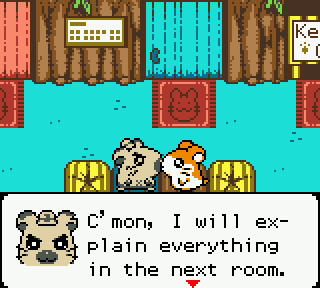
Boss, after fulfilling his role as Captain Exposition, immediately puts on Mr. Manual's hat.Finding the hamsters can be problematic in and of itself, especially if you aren't particularly familiar with the cartoon series this game is based off of. You are given their names and general location in the world. From there, locating your friends is standard RPG fare: explore, investigate strange-looking places, solve puzzles, fetch quest, talk to and/or bribe necessary characters. That sort of thing.
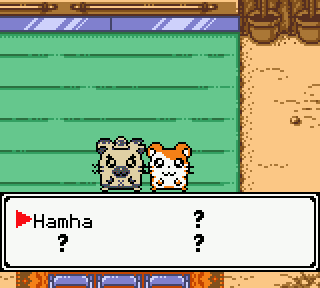
After you have located a character, convincing them to go back is the next step. While your friends seem generally helpful and accommodating, they each have various reasons to be too preoccupied or distressed to listen to you. You have to deal with whatever it is that is bothering them before they will listen to you and go back to the Clubhouse. Again, this involves the standard RPG fare of exploring, investigating strange-looking places, solving puzzles, fetch questing, talking to and/or bribing necessary characters, and so on.

Baby's first Ham-chat.A central element to the gameplay are Ham-chats. Ham-chat is, in essence, hamster jargon. If you want to advance the plot, you'd better learn to say "bizzaroo," because these snobby hamsters won't respond to such a plebian word as "strange." You will start the game off knowing 10 or so Ham-chat words and from there learn up to 82 more. You'll learn Ham-chats from unavoidable plot events, talking with NPCs, and side quests.

When speaking with other hamsters, you are prompted to choose from several Ham-chats (or question marks, representing Ham-chats you haven't learned but could use if you had). Which Ham-chat you use dictates how the hamster (or other creature) you are talking to responds. Choosing the "wrong" Ham-chat never ruins the game, but can often be entertaining, as you can insult, bite, or --in one case-- attempt to urinate on your conversation partner.

There are various optional elements to the gameplay. Throughout the game, you can buy clothing and accessories; in the Clubhouse, you can "dress-up" Hamtaro, which changes his appearance at the title screen. There are also "Ham-Jams" which you can collect and edit. These are short songs to which Hamtaro "dances".

Despite being an RPG, there are no battles in this game. There is one minigame that is mandatory, but not very hard.

The game auto-saves. You can only keep one save at a time.

Upon completing the main plot of the game, there is post-plot content. You can learn a few final Ham-chats and explore the world to gather some stars that have fallen.


THOUGHTS:
Despite being based on a children's cartoon license, this is a surprisingly fun game. I'd consider this a jRPG despite its lack of battles. I feel that the game is complete without battles, but others may disagree.

Puns abound.The game is genuinely funny. It focuses on kid-friendly humor like puns and wordplay. Logical contradictions are sometimes introduced as an element of humor. Reactions and expressions of characters are exaggerated for comic effect. You are given the option to interact with characters and scenery in multiple ways that product no plot effect, but produce entertaining scenes.

Hamtaro: Ham-Hams Unite embraces a light-hearted tone with a one-dimensional story and characters with simple and forthright complaints. It's a far cry from the typical jRPG, whose multilayered story must be deciphered by the collaborative efforts of a forum full of fans playing the game in multiple languages and using supplemental written material. The little cartoon hamsters of Ham-Hams Unite have simple and sometimes childish needs, but let's face it--those are much easier for a gamer to relate to than the angst of some prophesied hero whose family was slaughtered by the evil alien empire.

Another thing I enjoyed was that much of the game was non-linear. Now, some actions need to be completed in order to open access to the next section. However, some sections open simultaneously, and of course, once multiple sections are open, it is up to you to decide where to go and what to do. It feels very open in a way that most jRPGs don't.


LEVEL STRUCTURE:
There are 7 locations in the game. 1 location is the Clubhouse, where exposition occurs and hints can be obtained. If you get bored with plot, you can come to the Clubhouse and mess around with superfluous cute things the game put in for you.

The other 6 locations are the "levels" where most of the game actually occurs. When you begin the game, you have access to only one of these locations, Acorn Shrine. As you progress the plot (demonstrating some basic competency in the game), you gain access to more areas.

If, at any time, you learn all the Ham-chats in a level, the sunflower icon that marks it will begin to spin.


CONTROLS:
D-pad .... move cursor or character
select ... brind up Items menu; sort Dictionary
start .... access Dictionary menu; close Dictionary menu
A ........ bring up Ham-chat menu; select option from any menu
B ........ exit any menu; hold down to run


OPTIONS:
You can change the appearance of the title screen by dressing up Hamtaro in-game. You can edit Ham-Jams (optional mini-game).


1.15.2010

Mary-Kate and Ashley: Pocket Planner


story | gameplay | my thoughts |
level structure | controls | options

BASIC INFO:
Title ....... Mary-Kate and Ashley: Pocket Planner (North America, Europe)
Players ..... 1 (with limited multiplayer functionality)
Genre ....... edutainment
Subgenre .... organizer
Platform .... Game Boy Color (2000)


STORY:
None.


GAMEPLAY:
Upon starting the software for the first time (or everytime after the battery dies), you are prompted to set the date and time. Then, you are asked for your first name, middle name, last name, street address, zip code, city, state, phone number, birthday, favorite color. You can skip all of these except entering your first name.

In the main menu, there are 6 options:
  • Calendar: Look at the calendar, add and edit events.
  • Friends: Reveals a submenu with 4 choices -
    • G-mail: I'm taking a guess here, but I think this is something that lets you send messages to friends with a copy of the game.
    • Friends: Maintain an address book.
    • About You: You can edit your details here.
    • Match Up: Have a friend type in the same stuff you did when you first booted up the game. You will then be told how much you have in common.
  • To Do: Stuff that is on the calendar for you to do today.
  • Fun Stuff: Reveals a submenu with 6 choices -
    • Games: Reveals a submenu with 4 choices.
      • Drop to Shop: Help MK and Ashley shoplift! Catch the goods that one of them drops, while avoiding mops.
      • Fash Machine: Slots. You aren't actually betting anything, though.
      • Sliders: A 4x4 sliding puzzle.
      • Match 'em: Memory. 30 cards are turned, face down. You turn them over, 2 at a time, trying to make matches. Matches are removed, non-matches are flipped back onto their face.
    • Crush: A "Crush Indicator". You are instructed to point the Game Boy and press A, with the implication that you will find out whether or not the person you are pointing at has a crush on you. Apparently, my laptop has a pretty big thing for me (I love you, too, Lappy).
    • Ask Ashley: Magic 8 ball, essentially.
    • Clue: A pet sim. Feed and play with a dog named Clue.
    • Sun Sign: A horoscope...thing. No, it doesn't tell you how your day will be in vague terms. It tells you how compatible you are with people of other signs.
    • Pic Gallery: View pictures you unlock. Gamefaqs indicates that a new picture is unlocked for every 10k points you win in games, and that 16 pictures can be unlocked in this manner.
  • Tools: Reveals a submenu with 6 options -
    • Stopwatch: It's a stopwatch. Does not show time until you stop it.
    • Phone Dialer: Apparently designed to dial phone numbers for you by screeching into a handset. Kind of neat, if not entirely practical.
    • Beam: Appears to be some sort of multiplayer connectivity.
    • Clock: It's a clock.
    • About You: Like the one above, it allows you to reset (or set for the first time) information about yourself.
    • Help: A small, in-game manual.
  • Options: The option menu lets you adjust music and sound. It also lets you change the date and time, and shows you how much memory is taken up by all the stuff you've typed into the software. There's also a mysterious "color" setting, which has "on" and "off" options, but it doesn't seem to do anything.
This software is compatible with the Game Boy Printer. On the vast majority of screens, there is a print button, allow you to...well, print stuff, I assume.


THOUGHTS:
This is one for the collectors. I particularly like the Phone Dialer (haven't used a landline since I was a kid) and the in-game manual (still waiting for this to become standard).

The games are terrible. If you just want a fun game, don't get this.


LEVEL STRUCTURE:
There are levels in the shoplifting game.


CONTROLS:
D-pad .... move cursor
select ... main menu
start .... start screen
A ........ confirm choice
B ........ cancel


OPTIONS:
You can turn music on or off. You can turn sound on or off.


Mr. Chin's Gourmet Paradise


story | gameplay | my thoughts |
level structure | controls | options

BASIC INFO:
Title ....... Mr. Chin's Gourmet Paradise
Players ..... 1
Genre ....... platform
Subgenre .... n/a
Platform .... Game Boy (1990)


STORY:
"In this high skill action adventure game, Mr. Chin is in hot pusuit of his favorite treat. He has come all the way from China to eat as many luscious gourmet peaches as he can before anyone else discovers how to eat this unique treat. As Mr. Chin, you must pursue the mysterious Momos and zap them into peaches with your demoe beam. So hurry up and run, jump, zap and eat as many peaches as you can before they make dinner out of you!"


GAMEPLAY:
In Mr. Chin's Gourmet Paradise, your goal is to eat every enemy on the screen. By doing so, you advance to a new, more difficult stage, where you are once again tasked with eating all the enemies. And so on.

In order to eat an enemy, you must first make it safe to touch. To do so, you must trap it between two fryers*. You can set 1 fryer down with the B button; if you set a 2nd fryer down on the same horizontal plane as another, they will immediately zap anything that lays between them. If an enemy is zapped, it turns into a walking white peach. Touch it to eat it.

Only 4 enemies can appear on-screen at any given time, including edible enemies. However, a stage may require you to defeat more than 4 before moving onto the next stage. In such a case, when you eat an enemy, the next 1 spawns from the top of the screen.

Each stage is strongly reminiscent of a stage from the classic Mario Bros. arcade game, with a few Super Mario Bros. elements thrown in. Stages are composed of multiple, thin platforms upon which you and the enemies walk. These platforms are composed of bricks which you can destroy by jumping up repeatedly into them. Occasionally, power-ups are revealed within bricks. They are as follows:
  • bomb ... turns all on-screen enemies into edible peaches (most common)
  • flan ... grants Mr. Chin the ability to fly by repeatedly pressing the A button (2nd least common)
  • sushi ... grants Mr. Chin temporary invincibility (2nd most common)
  • Mr. Chin head ... extra life (least common)
Another similarity to the early Mario games is the pipe. At the center of the bottom of each stage is a pipe that Mr. Chin can use. It will drop Mr. Chin from the center of the top of the screen onto whatever platform is directly below. Enemies can also use this pipe.

For the first 8 stages, platforms have dashed holes which only Mr. Chin can drop through. After beating the 8th stage and being sent again to the 1st stage, enemies will begin dropping through these holes, as well.

There is a bonus round every 2 stages. These seem to serve no particular purpose other than giving you a chance to earn points (counted as KCAL). Points do not appear to do anything.

Game play appears to be endless. Each stage gets progressively harder for at least the first 16 stages (enemies start dropping through holes they couldn't before, and more enemies spawn). After a while it just repeats.

*The fryers actually look like half a head of lettuce, and act like bug zappers. The game doesn't give them a name. I'm calling them fryers, cuz why not?


THOUGHTS:
The game has an old, arcade-y kind of feel and simplicity to it. I played it for several hours in one go while hiding in my hotel room from the Nevada heat. I found it very relaxing and kind of interesting, in that 'window into the past' sort of way.

Objectively, I will say that this is not a very good game. The gameplay is far too repetitive, and I mean that as literally as possible. After a few minutes of play, the levels repeat themselves, over and over, without significant change. If you are looking for hidden gems of the era, you can pass this one by.

However, if you are interested in gaming history and curiosities of the era, keep an eye out for this one. Mr. Chin's Gourmet Paradise, with its blatant cosmetic and gameplay similarities to Mario Bros. and Super Mario Bros., is a great example of the kind of highly derivative content found during that era.


LEVEL STRUCTURE:
There are 8 levels. Upon completing the 8th level, the levels repeat, with slightly increased difficulty. Levels appear to repeat indefinitely. After every 2 levels, there is a timed bonus stage.


CONTROLS:
D-pad .... move Mr. Chin
select ... (doesn't appear to do anything)
start .... pause/unpause
A ........ jump; press repeatedly to fly (with power-up)
B ........ place fryer


OPTIONS:
None.


1.11.2010

Q Billion


story | gameplay | my thoughts |
level structure | controls | options

BASIC INFO:
Title ....... Q Billion (North America, Japan)
Players ..... 1-2
Genre ....... puzzle
Subgenre .... spatial reasoning
Platform .... Game Boy (1990)


STORY:
You are a mouse in a house and you seek to get out. But in order to reach the outside, you must make your way through 30 rooms, each with a myriad of stacked boxes. Since you are an obsessive-compulsive mouse, and cannot leave a room that has stacked boxes, you must unstack all the boxes in order to leave the house. Silly mouse.

REAL STORY:
None that I know of.


GAMEPLAY:
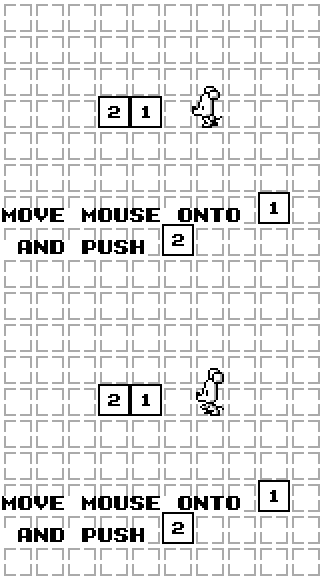
The first level attempts to be an explicit tutorial.Q billion is a spatial reasoning game. You are presented with a puzzle in which there are several stacks of boxes. These boxes have numbers representing how tall these stacks are. Your goal is to reduce all stacks to 1 box high. However, there are limitations.
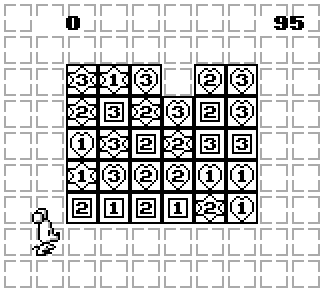
First, you can only push a stack that is 1 box tall.

Second, you can only topple a box that you are directly adjacent to; that is to say, if you want to topple the topmost box on a stack of 4 boxes, you must be sitting on a stack of 3 boxes next to it.

Finally, you cannot topple a stack of boxes, only the topmost box in a stack.

It gets a bit complicated after a while.There is an additional mechanic with magical disappearing blocks, but that is explained better in-game than I could possibly do here.

All in all, this actually makes for a fun puzzle game. I haven't quite played anything else like it, which is a shame, as the game would play MUCH better with modern graphics (the game is presented with a top-down perspective, and the numbers on the boxes are quite nonsensical until you figure out the relationship between them). I'd love to play a sequel that looked like Picross 3D.

1 player mode has a GAME A and GAME B. There is also an editor for constructing your own 1 player puzzles.

GAME A presents you with a series of unique, one-room puzzles. Upon completing the 30th puzzle, you receive a password that unlocks 10 additional puzzles.

Game B is weird.GAME B is a kind of versus mode that you play against the computer AI. Sorta. There are 5 "levels." Upon choosing a level, you are taken to a tic-tac-toe board, where you must choose 1 of the 9 squares, each of which represents a unique puzzle. If you solve the puzzle on this square quickly enough, you get to mark the board with your color. Your goal is to score 3 in a row, and then to win 5 "brackets." It's not all that exciting, except that you get 45 different puzzles out of it.

I have not been able to play using the 2 player mode, which I assume requires a second copy of the game, two Game Boys, and a link cable.


THOUGHTS:
I consider this a hidden gem and a must-play for puzzler fans, particularly retro puzzler fans. This is quite fun and presents some very challenging puzzles.

However, I must note that the visuals are absolutely terrible, and it may take quite some time to figure out what they are trying to depict. This game would be much better with a rotatable isometric viewpoint. I'd love to see a rerelease for iOS or another modern platform.

The music is really obnoxious, too.


LEVEL STRUCTURE:
GAME A has 40 levels. The first 30 are immediately accessible and the last 10 are unlocked with a password (received upon completing the 30th puzzle).

GAME B has 5 selectable "levels," each with 9 unique puzzles. No unlocking is necessary.

All puzzles are non-randomized.


CONTROLS:
D-pad .... move cursor
select ... cancel out of a menu (in some places)
start .... choose menu item
A ........ (in puzzle) push block
B ........ (in puzzle) undo last move


OPTIONS:
In GAME A, you can choose slow, normal, or fast. This controls how responsive the game is to your button presses. I prefer fast.


Quarth


story | gameplay | my thoughts |
level structure | controls | options

BASIC INFO:
Title ....... Quarth
Players ..... 1-2
Genre ....... shooter, puzzle
Subgenre .... vertically-oriented shoot 'em up, tile removal
Platform .... Arcade (1989), Famicom/NES (1990), Game Boy (1990), MSX2 (1990), Sharp X68000 (1990), mobile phone (2005), PS2 (2006), Wii Virtual Console (2010)


STORY:
There is a story to this, I bet. I'm sure it's a paper-thin, Arkanoid-esque story, but it's there. Hell if I know what it is. It's not explained in-game, I don't have the manual, and can't even find a copy online.


GAMEPLAY:
This is a hybrid between a vertically oriented shoot 'em up and tile removal block puzzler.

You are a ship. You shoot things. Enemies advance on you in a set pattern throughout 27 levels.

You shoot puzzle blocks. Your enemies are puzzle pieces formed from similarly shaped blocks. If you shoot at these pieces, your bullets will attach to them, changing their shape. Your goal is to change the shape of enemy pieces so that they form a rectangle, which destroys them.

Score a lot of points to get some power-ups to help you on the more difficult levels. A lightning-bolt shaped power-up will destroy all pieces on screen, while an arrow-shaped power-up will temporarily pause the advancement of enemies so you can destroy them at a more leisurely pace. There's at least one other power-up whose use I haven't yet figured out.


THOUGHTS:
This game is weird and I feel weird after playing it.

Did I just play a puzzle game? I love puzzle games! I love building up giant combos so I can blow up as many bricks as possible. It's like being a kid again, and making a giant tower of blocks so you can knock it down.

Did I just play a 2D vertically oriented shoot-em-up? I thought I hated those. I hate the monotonous rote memorization of enemy patterns, and Quarth certainly has that. It's even worse than a normal scrolling shooter because all the blocking enemies blook blike the blame blocking blocks.

Normal shooters at least let you mash the shoot button, which is nice and cathartic. But Quarth takes away this pleasure. Should you get trigger happy, blocks will stack up too far and crush you. For shame, Quarth! The ability to shooting indiscriminately is one of the few things I like about scrolling shooters!

On the other hand, the enemy in Quarth produce no projectiles and move in a very simple pattern. They're perfectly harmless until, you know, they crush you. Their slow, inexorable, and perfectly predictable advance provides an excellent opportunity to set up a line of kills. It feels good, methodically dispatching each fearsome block in the most efficient manner possible.

In the end, there is only 1 conclusion I can come to about the game: Quarth is weird. I don't know if I can say that like it, but I keep playing it.


LEVEL STRUCTURE:
There are 3 worlds, each with 9 levels. 1-1 is the easiest to beat while 3-9 is the hardest, with difficulty determined by the speed, density, and complexity of "enemy" advancement. You begin the game with access to all 27 levels.


CONTROLS:
D-pad .... move cursor; during a puzzle, press LEFT or RIGHT to move ship and press UP to speed up block advancement
select ... select 1P or 2P match
start .... choose menu item; pause/unpause
A ........ shoot
B ........ use powerup


OPTIONS:
There are 6 ships you can choose from before beginning play. This slightly affects the graphics of the puzzle, and changes the background music.


1.08.2010

Trax


story | gameplay | my thoughts |
level structure | controls | options

BASIC INFO:
Title ....... Trax (North America), Totsugeki! Poncotts Tank (Japan)
Players ..... 1-4
Genre ....... shooter
Subgenre .... 3rd person point-of-view
Platform .... Game Boy (1991)


Kirby tank.STORY:
Two factions are at war with each other. The big fat meanie faction abandons one of its malfunctioning tanks in underdog territory, and the plucky underdogs rehabilitate the tank and take it out for a cruise...of revenge!


GAMEPLAY:
It's a party and everygun's invited!Drive a suspiciously Kirby-esque tank around the countryside and blow stuff up. The screen "scrolls" vertically sometimes and horizontally at other times, but you are always moving at your own pace. There are some entertaining weapon upgrades, but the game is so easy that you probably don't need them. They're just, y'know, fun.
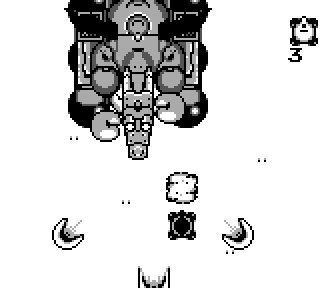

You get to fight some goofy-ass bosses. Don't worry too much about dying because you have infinite continues.


THOUGHTS:
I had a lot of fun with this. It's cute, light-hearted, and incredibly forgiving. Just about right for 50 cents, or whatever it was I wound up paying for it. I can't say how fans of the genre will take the game, as I might be the shooter anti-fan. Also, it is very, very short (which I consider a point in its favor).


The underdogs had no hope against the Dragon Mecha Tank With Boxing Gloves until they got the bitty Kirby Tank.LEVEL STRUCTURE:
There are 4 levels, each with a miniboss and a boss. The final level features a boss rush.


CONTROLS:
D-pad .... move your tank
select ... no apparent use
start .... pause
A ........ rotate cannon clockwise 45 degrees
B ........ shoot


OPTIONS:
None.


1.06.2010

V.I.P.


story | gameplay | my thoughts |
level structure | controls | options

BASIC INFO:
Title ....... V.I.P. (North America, Europe)
Players ..... 1
Genre ....... multiple
Subgenre .... multiple
Platform .... Game Boy Color (2001)


VIPSTORY:
An actor has been nominated to receive an award, but his fiancee has informed the press that he's gone missing. You and your buddies have been put on the case. Not only do you need to find the missing person, but you need to do so in time for him to catch the awards ceremony tonight.


GAMEPLAY:
This game is composed of multiple segments, each of which is its own genre.

Throughout the game, you must watch your health and lives. Your health is represented by 5 hearts, with any damage taking off 1 heart. Lose all your hearts and you will lose a life. You can stock a total of 9 extra lives. In addition to items that restore health and grant extra lives, there are also shields that grant invincibility in all parts of the game.

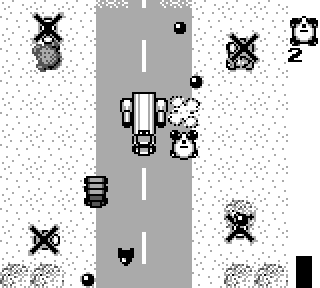
There are 3 pseudo-racing segments. Your goal is to reach the end of a set map without losing your lives. Working against you are environmental hazards that will take away your health (other cars that can crash into you, sandpits that will turn you over) and your limited fuel. If you run out of fuel, you lose a life. Fortunately, there are plentiful fuel refills (health, and life) scattered along the road.

A 4th pseudo-racing segment is similar to the above, only it is vastly simplified by the removal of fuel. You are, coincidentally, driving a boat.

There are 2 skating segments. Again, your goal is to reach the end of a set map without losing your lives. Working against you are banana peels, irate kiosk staffers, balloons, and the dreaded stairs. Skate forward and jump over these obstacles to reach your goal. If you want to get fancy, grab some balloons while you're at it.

There are 4 shooter segments, though they are equally divided among two different genres. In two segments, you guide a character on-foot across a standard "full of baddies" map. This is done in a top-down, 3rd person perspective. You cannot run out of bullets, but you can collect, use, and run out of grenades. The other two segments are standard vertically scrolling shooters, complete with ammo upgrades.

Finally, there are 4 platforming sections (2 of which are consecutive). The platforming sections are fairly standard run and jump/gun, with baddies to shoot and all that whatnot. You can run out of ammo only in the platforming sections; consequentially, there are items which restore you ammo. If you do run out of ammo, you are restricted to close-range combat using your purse.


THOUGHTS:
I enjoyed this game. It's not hard by any stretch of the imagination, mind you, but I did enjoy exploring stages and getting to see what the next stage was like.

I also experienced a bit of "baby's first shooter/racer". I typically avoid those genres, and I can't say I cared much for the racing segments in this game. However, the scrolling shooter segments were entertaining, and I have a greater interest in "real" scrolling shooters now.


LEVEL STRUCTURE:
14 named segments. You can obtain passwords.


CONTROLS:
D-pad .... move cursor; move character
select ...
start .... pause
A ........ confirm/enter/choose
B ........ cancel


OPTIONS:
Choose to play in English, Spanish, or French (a screenshot on Mobygames suggest that the EU version may also offer Italian and German, but those are not options on my NA copy). Turn music on or off. Turn sound effects on or off.


EXTRA NOTES:
Based off an "action/comedy-drama" TV show aired from 1998 to 2002.

There are V.I.P. games for other platforms, but they do not appear to be the same as this game. The game for the GBA is, according to Mobygames, "a side-scroller with 8 levels", while the PS2/PC game is a fighting game.