story | gameplay | thoughts |
level structure | controls | options
BASIC INFO:
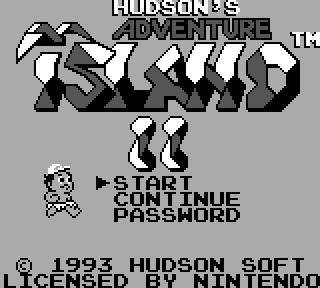
Title ....... Adventure Island II: Aliens in Paradise (North America), Takahashi Meijin no Boukenjima III (Japan)
Players ..... 1
Genre ....... platformer
Subgenre .... side-scroller
Platform .... NES (1992), Game Boy (1993)
 STORY:
Your girlfriend has been kidnapped by aliens. Well?
GAMEPLAY:
Each level consists of a short side-scroller segment. Almost every level scrolls from left to right, and as you scroll parts of the level off to the left of the screen, those parts become inaccessible. A few levels also move up-down.
Enemies and environmental hazards are the most familiar difficulties preventing you (Master Higgins) from completing a level. Enemies can be avoided or defeated using a weapon, which you can obtain from eggs scattered about levels. Environmental hazards, such as pits or fire, typically must be avoided.
 Hunger, a reappearing element in the Adventure Island games, is another difficulty that must be contended with. You have an energy meter at the bottom of the screen which functions a little like a timer, in that it steadily decreases and you will lose a life if you allow it to completely empty. However, unlike most timers of the era, the energy meter can be refilled by eating food. Fruit (which refills your meter slightly) appears frequently, while meat (which refills it completely) may appear once in a stage, in a hidden or difficult to reach area.
Vehicles speed up your progress through a level, helping you avoid a death-by-hunger. A skateboard is available, as are 5 different dinosaur companions. 4 of these dinosaurs are uniquely suited for different terrain (lava, ice, water, air) and give you access to a special attack, 1 per dinosaur. The 5th dinosaur can barrel through nearly any enemy or obstacle.
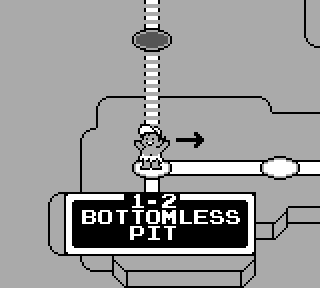 Levels are arranged on a world map, allowing for back-tracking and replaying previous levels. A surprising number of secrets are hidden on these very short levels, from bonus stages to warps to simple power-ups. Keep an eye on the terrain directly behind you, and don't feel bad about randomly attacking walls.
You cannot save, but a unique password is provided upon completion of each world. So long as you do not turn off or reset the console, you have infinite continues that remember the level on which you died and the number of items you had at the time of death.
THOUGHTS:
This is a classic example of the sort of absurdity that was standard fare in the 80s and early 90s. The plot, such as you can infer from the animations and sprites, is ridiculous. The setting is a bizarre mishmash of whatever seems cool from other settings (dinosaurs! skateboards! aliens!). The mood, as set by the graphics and music, is cheerful and cartoony, strictly at odds with the constant threat of death from hunger, floating skulls, and eggplants. And, of course, your character dies if he so much as brushes against a vile enemy--like a bird.
I loved the days when this kind of stuff was standard.
The game is short and easy if you want it to be short and easy. If you want more content, that content is there to be found. The game won't make you find it, though, and the only reward for finding it is, well, finding it. If you want achievements or other external motivation to get the most of your game, you will probably not enjoy Adventure Island II.
I seem to recall reading an opinion piece where a gamer talked about how they liked the series's hunger mechanic and the sense of urgency it added to the game. At the time, I scoffed at the idea, but now I'm inclined to agree. While I still like being given the time to explore a level at leisure, the levels in this game are--as mentioned--short. I can get a sense of accomplishment from successfully completing a level without running out of food, and then immediately replay the same level for secrets without feeling like my time has been wasted. This provides for a sort of "one more go" experience missing from the platformers with huge, sprawling levels that take a substantial time investment to explore.
LEVEL STRUCTURE:
[World #]-[Level # or LETTER]
There are 8 worlds.
Each world has levels 1 through 6 and a level A and B. You do not need to complete all 8 levels to reach the next world.
The #-6 level of each world has a boss at its end. Completing this level opens up the next world. You can frequently warp past levels by finding secret areas.
CONTROLS:
D-pad .... move cursor, move character
select ... exit out of a level from the item selection screen
start .... pause/unpause
A ........ jump, swim; choose item from item selection screen
B ........ attack; move more quickly (run, fly); remove items from item selection screen
OPTIONS:
None to speak of. However, there are "secret" passwords that will allow you to start off the game with variables changed. 1984 seems to be the "ultimate" password which starts you off with 99 lives, 99 of all items, and all levels unlocked, but I don't know the significance of the date.