level structure | controls | options
BASIC INFO:
Title ....... Breakthru! (North America)
Players ..... 1-2
Genre ....... puzzle
Sub-genre ... falling tile, matching tile, tile removal
Platform .... DOS (1994), Game Boy (1995), SEGA Saturn (1995), SNES (1994) and Windows 3.x (1994)
 STORY:
None.
GAMEPLAY:
Your goal in Breakthru! is to remove all tiles from the playing field. You begin with a screen that is filled with tiles. There are regular tiles which can be differentiated by pattern (as the Game Boy was monochromatic). You can remove these tiles by clicking on any group of them, even if the group is composed of only 2. When removed, tiles from above fall down, creating new groups that can be removed.
You may have played this before under the name ChainShot! or SameGame. If you have, you'll know it can get very difficult to destroy the last few tiles. Thus, it is helpful that new tiles are constantly falling from the top of the screen. You can force drop these pieces by holding down B and pressing down on the D-pad; you can also position them by holding down B and pressing left or right on the D-pad.
To make it even easier, you have special tiles. These include:
- wild cards: allow you to destroy all tiles of one type (rare)
- rockets: flies in 1 direction and destroys all tiles in its flight path
- bombs: You can choose to detonate any bomb that reaches the bottom row of the playing field. It will destroy every adjacent tile, including diagonally adjacent tiles. If a bomb is one of those diagonally adjacent tiles, it, too, will detonate, following the same rules. If two bombs ever actually touch (diagonals not included) they will automatically detonate.
There are also spiders. These are not tiles, and do not need to be destroyed in order to clear a stage. However, they can be destroyed by special tiles such as rockets or bombs. You may want to do this as spiders get in the way of your falling blocks, making it difficult to clear the field.
THOUGHTS:
First things first: if you have full color vision, you probably would prefer a different version of Breakthru!. The monochrome version of the game really tires your eyes out. Unfortunately, the color versions I've seen screenshots for (SNES, Windows 3.x) are not color-blind friendly.
As for the game itself, well...how do you like your SameGame? Personally, I prefer that my falling block puzzles be endless, so Breakthru! is an improvement over the original SameGame rules, where your puzzle ends as soon as you clear or fail to clear the field. However, I think I may prefer the more classic "endless" SameGame rules variant, described on Wikipedia as such:
- "In an "endless" variant, the game starts with an empty field. The blocks or balls start falling down; but if they reach the top, new blocks stop falling, so they do not overflow—thus, the game never ends. The player can end the game at any time by waiting for blocks to reach the top, then performing a special action (for example, right-click instead of left-click)."
I think, in the end, I'd like to see a reintroduction of Breakthru with a combination of the gameplay from the Game Boy game and the "endless" gameplay described in the above quote. As the player reaches a certain score point, special tiles would generate at different rates (weights becoming more common, for instance), and spiders would spawn where a tile just disappeared.
LEVEL STRUCTURE:
[world #] [level NAME] [round #]
There are 4 "worlds" (for lack of a better term). The first level of every world is called Berlin. In Berlin (as in each of the 6 levels) you play 4 rounds. After you complete the 4th round, you get a "Level Complete" message and move onto the next level. The levels are, in order: Berlin, London, S.F., Moscow, N.Y., and Beijing. There are 98 total rounds on any single difficulty level.
Upon beating 4 Beijing 4, you loop back around to 4 Berlin 1.
CONTROLS:
OPTIONS:
There are 3 difficulty settings (easy, normal, hard). There are 3 time settings (2, 5, and 10 minutes). Music can be toggled on and off. Sound effects can be toggled on and off. The puzzle background can be toggled on and off (fortunate, because it is very distracting. Credits can be accessed at any time from the options menu.

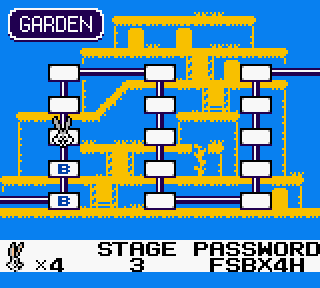
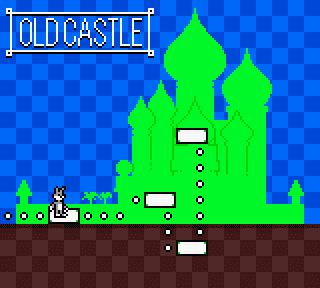
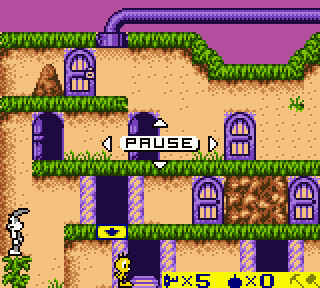 Your goal in Bugs Bunny: Crazy Castle 3 is to clear all 61 stages of the Old Castle. To clear a stage, you must collect the 8 keys scattered about, then proceed to the locked door which leads to the next stage.
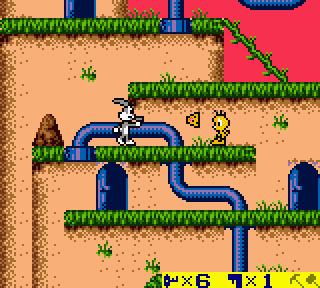 You can disable your enemies/friends. Or, more accurately, you can blow up, crush, and shoot them with the various items you find laying about (bombs, anvils, and very lethal cork pop guns). Use these items well, and your pursuers will be destroyed with a comic puff of air, leaving you to explore the area at a slightly more leisurely pace.
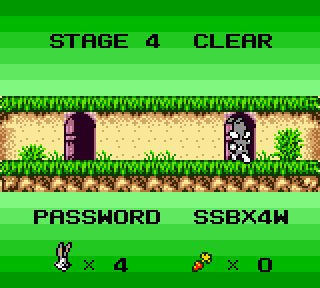 The game doesn't save your progress, but it does give you passwords. A password saves not just the level you are on, but it also seems to save the number of lives you've earned. Continues in the game are infinite. Additionally, you earn a life every time you complete a stage successfully, find 1ups in stages, and earn 1ups by collecting carrot icons.
 I've heard a lot of praise for the Crazy Castle series, and I have fond memories of Kemco's Bugs Bunny Birthday Blowout for the NES -- a straightforward and simple action-based platformer that I played with my brothers. This game seemed like a winner: I'm a fan of puzzle platformers, I'd had a good experience with the developer making a similar game, and retro gamers agreed it was a good game from a good series. I was happy to get a copy.